 0 items
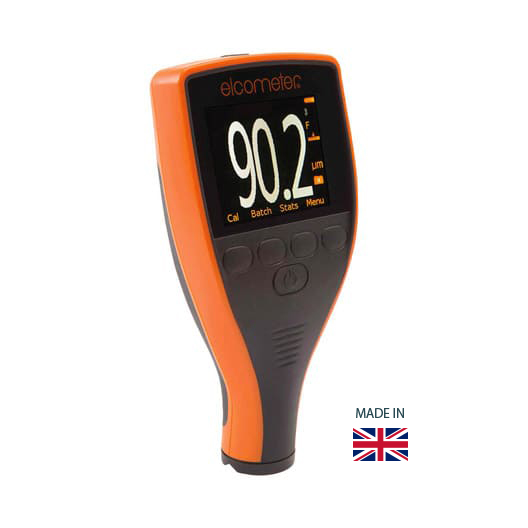
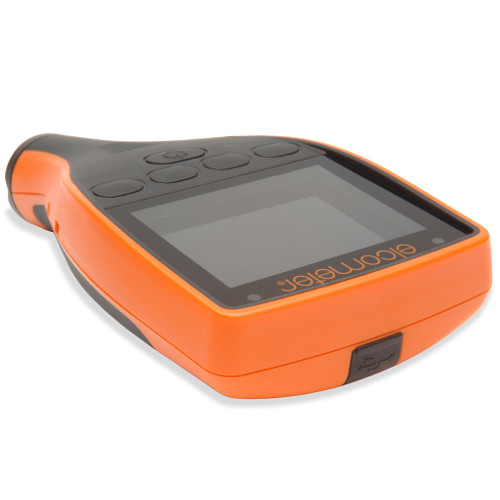
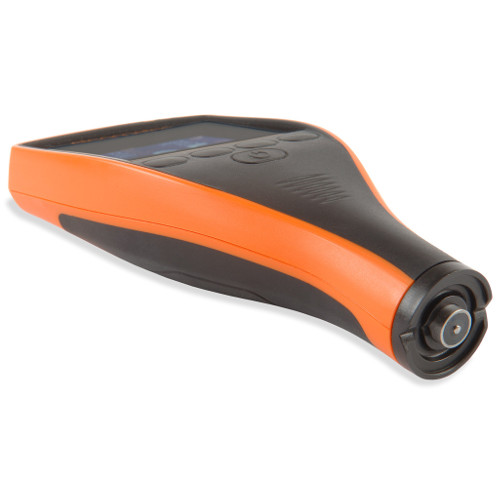
A professional instrument for measuring dry film thickness (DFT) on ferrous and non-ferrous metal substrates.
Designed for inspectors, coating contractors, manufacturers, and quality assurance professionals, it delivers fast, repeatable measurements that help verify coating quality, ensure specification compliance, and document inspection results.
Available in multiple models with integrated or separate probes, the Elcometer 456 adapts to virtually any coating inspection application. Whether measuring painted steel, galvanized structures, pipelines, bridges, marine vessels, or powder-coated components, the gauge combines accuracy, durability, and advanced data management in a rugged handheld design.
Instant readings allow inspectors to evaluate large coated surfaces efficiently while maintaining consistent quality control throughout production or field inspections.
Depending on the selected probe configuration, the gauge measures coatings on steel, iron, aluminum, stainless steel, and other non-ferrous metals. Automatic substrate recognition allows seamless switching between ferrous and non-ferrous materials without requiring manual adjustments.
Each ELCOMETER 456 model offers further functionality to assure the success of your project. Our most advanced Model T features memory, alpha-numeric batching, and Bluetooth® communication.
Ferrous Metal Coating Thickness Gauge for Shot or Grit Blasted Surfaces Range : 0 – 1500μm (0 – 60mils) Add to cart
Ferrous Metal Coating | Scale 1 | Model B | Range: 0-60 mils Add to cart
Non-Ferrous | Scale 1 | Model B | Range: 0-60 mils Add to cart
Ferrous/Non-Ferrous | Scale 1 | Model B | Range 0-60 mils Add to cart
Ferrous Metal | Scale 1 | Model S | Range: 0-60 mils Add to cart
Ferrous Metal | Scale 1 | Model T | Range: 0-60 mils Add to cart
Ferrous | Scale 2 | Model B | Range: 0-200 mils Add to cart
Ferrous Metal | Scale 3 | Model B | Range: 0-500 mils Add to cart
Ferrous/Non-Ferrous | Scale 1 | Model S Range 0-60 mils Add to cart
Ferrous/Non-Ferrous | Scale 1 | Model T Range: 0-60 mils Add to cart
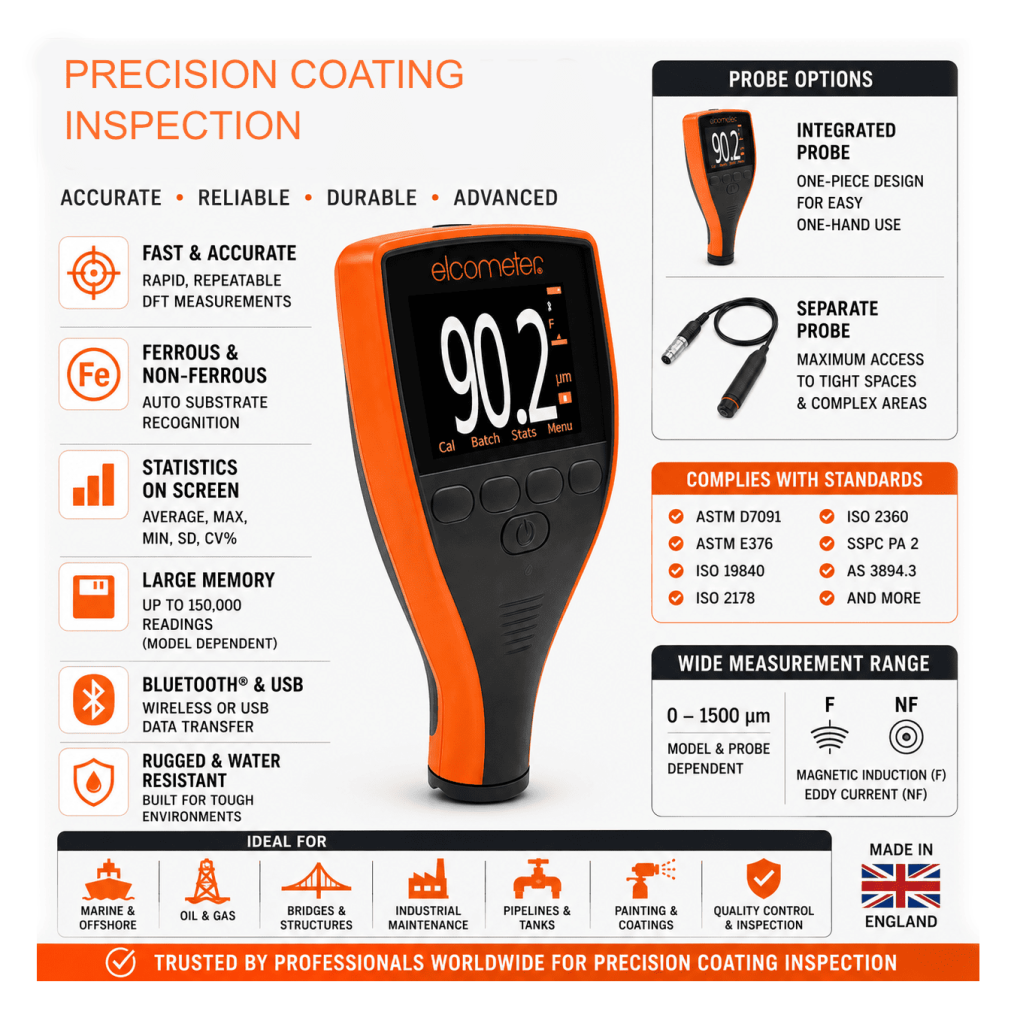
Great for harsh environments, the Elcometer 456 is a heavy duty, impact resistant instrument, with dust and water resistance equivalent to IP64. Storing up to 150,000 readings in 2,500 batches and to measuring up to 13mm (500mils) of coating, it is a perfect gauge for working on very large surfaces.
Pre-calibration included: You can start measuring on the stop, having selected the correct surface profile.
Easy to use: Minimal training required: (https://www.youtube.com/watch?v=OdlFDMHaXCw)
Results transferred via Bluetooth® or USB to ElcoMaster® or your software for instant report generation
Multiple languages: English, French, Spanish, German, Chinese & Japanese
Built-in integral probe for reliable readings on flat or curved surface
Displays 3 individual readings and their average in microns or mils
Pre-calibrated with 4 profile ranges: Smooth 0-25µm 0-1mil Fine 25-60µm 1-2mils Medium 60-100µm 2-3mils Coarse >100µm 3-4mils
Integrated and Separate Probe Options
The Elcometer 456 is available with integrated probes for convenient one-handed operation or separate probes for inspecting difficult-to-access locations, inside pipes, complex geometries, and large structures. Multiple probe ranges are available to suit different coating thickness requirements.
Advanced Memory and Statistical Analysis
Higher-level models provide onboard memory for thousands of readings, organized into batches with comprehensive statistical analysis including average, standard deviation, highest, lowest, and coefficient of variation. These features simplify inspection reporting and quality documentation.
USB and Bluetooth® Connectivity
Measurement data can be transferred through USB or Bluetooth® to ElcoMaster® software for report generation, data analysis, and long-term record management. Wireless connectivity also allows integration with mobile devices for faster reporting directly from the inspection site.
Supports International Coating Inspection Standards
The Elcometer 456 is designed to support dry film thickness measurements performed in accordance with numerous internationally recognized standards, including ASTM D7091, ASTM E376, ISO 19840, ISO 2178, ISO 2360, SSPC PA 2, AS 3894.3, and other industry specifications.
Dry film thickness gauges are widely used in protective coatings, marine maintenance, offshore structures, oil and gas, petrochemical facilities, bridge construction, structural steel fabrication, automotive manufacturing, aerospace, powder coating operations, industrial finishing, pipeline inspection, and quality assurance laboratories.
Inspection professionals value the Elcometer 456 for its accuracy, durability, flexible probe options, comprehensive reporting capabilities, and compliance with international standards. Its ability to combine fast measurements with advanced statistical analysis makes it one of the industry’s most widely used coating thickness gauges.
Elcometer 456 features |
Standard |
Optional |
|
| Model B | Model S | Model T | |
| Fast, accurate reading rate; 70+ readings per minute | ● | ● | ● |
| Repeatable & reproducible measurements | ● | ● | ● |
| Easy to use menu structure; in 30+ languages | ● | ● | ● |
| Tough, impact, waterproof & dust resistant; equivalent to IP64 | ● | ● | ● |
| Bright colour screen; with permanent backlight | ● | ● | ● |
| Scratch & solvent resistant display; 2.4” (6cm) TFT | ● | ● | ● |
| Large positive feedback buttons | ● | ● | ● |
| USB power supply; via PC | ● | ● | ● |
| Test certificate | ● | ● | ● |
| 2 year gauge warranty1 | ● | ● | ● |
| Automatic rotating display; 0°, 90°, 180° & 270° | ● | ● | ● |
| Ambient light sensor; with adjustable auto brightness | ● | ● | ● |
| Emergency Light | ● | ● | ● |
| Tap awake from sleep | ● | ● | ● |
| Gauge software updates2; via ElcoMaster® software | ● | ● | ● |
| Data Output | ● | ● | ● |
| USB; to computer | ● | ● | ● |
| Bluetooth®; to computer, Android™ & iOS3 devices | ● | ● | ● |
| On Screen Statistics | ● | ● | ● |
| Number of readings; η Mean (average); x, Standard deviation; σ Highest reading; Hi, Lowest reading; Lo, Coefficient of variation; CV%, Elcometer index value4; EIV | ● | ● | |
| Nominal dry film thickness; NDFT | ● | ● | |
| IMO PSPC; %>NDFT, %>90 <NDFT, 90:10 pass/fail | ● | ● | |
| High & low limits; definable audible & visual alarms | ● | ● | |
| Number of readings above high limit; | ● | ● | |
| Number of readings below low limit; | ● | ● | |
| Live reading trend graph; in Batch Mode | ● | ● | |
| ElcoMaster® software & USB cable | ● | ● | ● |
| Replaceable screen protectors | ● | ● | ● |
| Protective case | ● | ● | ● |
| Plastic transit case | ● | ● | ● |
| Separate models; with automatic probe recognition | ● | ● | ● |
| Probe type; Ferrous (F), Non-Ferrous (N), Dual (FNF) |
F, N, FNF
|
F, N, FNF
|
F, N, FNF
|
| Measurement Range |
0-31mm (0-1,220mils)
|
0-31mm (0-1,220mils)
|
0-31mm (0-1,220mils)
|
| On screen calibration instructions; in 30+ languages | ● | ● | ● |
| Multiple calibration methods | ● | ● | ● |
| Factory; resets to the factory calibration | ● | ● | ● |
| 2-point; for smooth and rough surfaces | ● | ● | ● |
| 1-point; zero calibration | ● | ● | ● |
| Zero offset; for calibration according to ISO19840 | ● | ● | ● |
| Predefined calibration & measurement methods | ● | ● | |
| ISO, SSPC PA2, Swedish, Australian | ● | ● | |
| Automatic calibration; for rapid calibration | ● | ● | |
| Calibration memory type; gauge (g) or gauge & batch (gb) |
g
|
gb
|
gb
|
| Number of batches; with unique calibrations |
1
|
2,500
|
|
| Calibration memories: 3 programmable memories | |||
| Measurement outside calibration warning | |||
| Calibration lock; with optional PIN Code Unlock | |||
| Delete last reading | |||
| Gauge memory; number of readings |
Last 5
|
1,500
|
150,000
|
| Individual batch calibrations; sent to PC via ElcoMaster® software | ● | ● | |
| Limits; user definable audible & visual pass/fail warnings | ● | ● | |
| Gauge (g) or gauge & batch specific (gb) limits |
g
|
gb
|
|
| Date & time stamp | ● | ● | |
| Review, clear & delete batches | ● | ● | |
| Batch types; normal, counted average, IMO PSPC | ● | ● | |
| Navsea Mode | ● | ||
| Batch review graph | ● | ||
| Copy batches and calibration settings | ● | ||
| Alpha-numeric batch names; user definable on the gauge | ● | ||
| Scan & Auto Repeat Modes; with Scan Probe connected | ● | ||
| Fixed Batch Size Mode; with batch linking | ● | ||
SAVE BIG – SLASH YOUR COSTS BY GETTING A COMPREHENSIVE KIT FOR YOUR PROJECT
FERROUS / NON-FERROUS METAL INSPECTION KIT | LARGER PROJECTS INSPECTION KIT 5 | ALL-INCLUSIVE STRUCTURES ASSESSMENT KIT 6 | SEE ALL ELCOMETER KITS AVAILABLE FOR SALE
Elcometer 456 calibration
As the gauge is factory calibrated, the calibration cannot be adjusted by the user and the gauge should be returned to Elcometer for re-calibration. The user can, however, verify the accuracy of the gauge calibration in the field using the ‘Test Calibration’ option. To test the calibration, press Cal/Test Calibration and follow the on-screen instructions. Just select the relevant surface profile and start measuring.
STANDARDS: ASTM D7091, ISO 2808, ISO 19840, SSPC PA-2, US Navy NSI 009-32.
Supplied with Test Certificate.
How to use Elcometer 456:
1. Whilst holding the gauge perpendicular, gently place the probe onto the surface.
· Do not drag the probe across the surface or bang the probe down hard onto the surface as this will damage the probe tip resulting in inaccurate readings.
· >1500µm’ (’>60mils’) indicates a reading over the probe range.
2. For subsequent readings, lift the probe off and then replace it on the coated surface.
· Do not allow the probe to hover over the surface as this could result in a false reading.
The first reading taken is displayed next to ‘1′, the second next to ‘2′ etc. When the third reading has been taken, the average (mean, xbar) of the three individual readings displayed is shown (X:).
The average (mean, xbar) reading is cleared when a fourth reading is taken.
By selecting ‘Send Individual Readings’ or ‘Send Mean (xbar) Reading’ via Menu/Bluetooth, the user can choose to transfer the individual readings or just the average (mean, xbar) reading values to ® ® ElcoMaster or ElcoMaster Mobile Apps – see Section 7 on page 7.
Download Data Sheet
Download Elcometer 456 Manual
Q&A
When Should I Use Scan Mode Instead of Single Readings?
Scan mode is ideal when inspecting large coated surfaces or verifying compliance over broad areas. It captures multiple measurements continuously as the probe moves across the surface, making it easier to locate thin spots or coating variations that could be missed with isolated spot measurements. Single readings are better suited for precise measurements at specific inspection points or when following a defined measurement procedure.
How Does the Elcometer 456 Help Comply with SSPC PA 2?
The Elcometer 456 includes measurement modes and statistical functions that support inspection procedures outlined in SSPC PA 2 for dry film thickness verification. Stored readings, batch organization, averaging, and statistical calculations help inspectors document compliance with specified coating thickness requirements while producing traceable inspection records.
Can the Elcometer 456 Measure Duplex Coating Systems?
Yes. The gauge can measure the total thickness of non-magnetic coating systems applied over steel, including duplex systems such as galvanizing with an additional paint or powder coating layer. It reports the combined coating thickness rather than the thickness of each individual layer.
How Often Should a Coating Thickness Gauge Be Verified or Calibrated?
The gauge should be verified before each inspection using certified coating thickness standards or calibration foils appropriate for the expected measurement range. Full calibration intervals depend on your company’s quality system, manufacturer recommendations, and applicable industry standards, but routine verification before use is considered good inspection practice.
What Probe Range Is Best for Thick Epoxy or Fireproofing Coatings?
High-range probes are generally recommended for thick protective coatings, heavy epoxy systems, and intumescent fireproofing. Selecting the proper probe range ensures the required measurement capacity while maintaining the best possible accuracy throughout the expected coating thickness range.
How Does the Elcometer 456 Compare with Ultrasonic Coating Thickness Gauges?
The Elcometer 456 measures non-destructively on metal substrates using magnetic induction and eddy current technologies. Ultrasonic coating thickness gauges are designed for coatings applied to non-metallic substrates such as concrete, plastics, composites, or wood, or for measuring individual layers within certain multi-layer coating systems. The appropriate instrument depends primarily on the substrate material and inspection requirements.
What Measurement Errors Can Occur on Rough Blast-Cleaned Steel?
Surface profile can increase coating thickness readings because the probe measures from the tops of the blast profile while the coating fills the valleys below. For accurate inspection, measurements should follow the applicable coating specification and recognized standards, taking substrate roughness into account during calibration and interpretation of results.
Can Coating Thickness Be Measured on Curved Pipes or Small-Diameter Components?
Yes. The Elcometer 456 offers probe options specifically designed for curved surfaces, pipes, small parts, and other challenging geometries. Separate probes often provide better access and positioning on confined or irregular surfaces than integrated probe models.
How Does Substrate Roughness Affect Dry Film Thickness Readings?
Blast-cleaned steel and other rough substrates create natural variations in coating thickness because the coating follows the surface profile. As a result, individual readings may vary across the surface. Taking multiple measurements and evaluating the average in accordance with the applicable inspection standard provides a more representative assessment of the coating thickness.
Source web page with instructions
You may also be interested in:
Elcometer 456 Digital Coating Thickness Gauge with detachable probe variety
A professional instrument for measuring dry film thickness (DFT) on ferrous and non-ferrous metal substrates.
Designed for inspectors, coating contractors, manufacturers, and quality assurance professionals, it delivers fast, repeatable measurements that help verify coating quality, ensure specification compliance, and document inspection results.
Available in multiple models with integrated or separate probes, the Elcometer 456 adapts to virtually any coating inspection application. Whether measuring painted steel, galvanized structures, pipelines, bridges, marine vessels, or powder-coated components, the gauge combines accuracy, durability, and advanced data management in a rugged handheld design.
Instant readings allow inspectors to evaluate large coated surfaces efficiently while maintaining consistent quality control throughout production or field inspections.
Depending on the selected probe configuration, the gauge measures coatings on steel, iron, aluminum, stainless steel, and other non-ferrous metals. Automatic substrate recognition allows seamless switching between ferrous and non-ferrous materials without requiring manual adjustments.
Each ELCOMETER 456 model offers further functionality to assure the success of your project. Our most advanced Model T features memory, alpha-numeric batching, and Bluetooth® communication.
Ferrous Metal Coating Thickness Gauge for Shot or Grit Blasted Surfaces Range : 0 – 1500μm (0 – 60mils) Add to cart
Ferrous Metal Coating | Scale 1 | Model B | Range: 0-60 mils Add to cart
Non-Ferrous | Scale 1 | Model B | Range: 0-60 mils Add to cart
Ferrous/Non-Ferrous | Scale 1 | Model B | Range 0-60 mils Add to cart
Ferrous Metal | Scale 1 | Model S | Range: 0-60 mils Add to cart
Ferrous Metal | Scale 1 | Model T | Range: 0-60 mils Add to cart
Ferrous | Scale 2 | Model B | Range: 0-200 mils Add to cart
Ferrous Metal | Scale 3 | Model B | Range: 0-500 mils Add to cart
Ferrous/Non-Ferrous | Scale 1 | Model S Range 0-60 mils Add to cart
Ferrous/Non-Ferrous | Scale 1 | Model T Range: 0-60 mils Add to cart
Great for harsh environments, the Elcometer 456 is a heavy duty, impact resistant instrument, with dust and water resistance equivalent to IP64. Storing up to 150,000 readings in 2,500 batches and to measuring up to 13mm (500mils) of coating, it is a perfect gauge for working on very large surfaces.
Pre-calibration included: You can start measuring on the stop, having selected the correct surface profile.
Easy to use: Minimal training required: (https://www.youtube.com/watch?v=OdlFDMHaXCw)
Results transferred via Bluetooth® or USB to ElcoMaster® or your software for instant report generation
Multiple languages: English, French, Spanish, German, Chinese & Japanese
Built-in integral probe for reliable readings on flat or curved surface
Displays 3 individual readings and their average in microns or mils
Pre-calibrated with 4 profile ranges: Smooth 0-25µm 0-1mil Fine 25-60µm 1-2mils Medium 60-100µm 2-3mils Coarse >100µm 3-4mils
Integrated and Separate Probe Options
The Elcometer 456 is available with integrated probes for convenient one-handed operation or separate probes for inspecting difficult-to-access locations, inside pipes, complex geometries, and large structures. Multiple probe ranges are available to suit different coating thickness requirements.
Advanced Memory and Statistical Analysis
Higher-level models provide onboard memory for thousands of readings, organized into batches with comprehensive statistical analysis including average, standard deviation, highest, lowest, and coefficient of variation. These features simplify inspection reporting and quality documentation.
USB and Bluetooth® Connectivity
Measurement data can be transferred through USB or Bluetooth® to ElcoMaster® software for report generation, data analysis, and long-term record management. Wireless connectivity also allows integration with mobile devices for faster reporting directly from the inspection site.
Supports International Coating Inspection Standards
The Elcometer 456 is designed to support dry film thickness measurements performed in accordance with numerous internationally recognized standards, including ASTM D7091, ASTM E376, ISO 19840, ISO 2178, ISO 2360, SSPC PA 2, AS 3894.3, and other industry specifications.
Dry film thickness gauges are widely used in protective coatings, marine maintenance, offshore structures, oil and gas, petrochemical facilities, bridge construction, structural steel fabrication, automotive manufacturing, aerospace, powder coating operations, industrial finishing, pipeline inspection, and quality assurance laboratories.
Inspection professionals value the Elcometer 456 for its accuracy, durability, flexible probe options, comprehensive reporting capabilities, and compliance with international standards. Its ability to combine fast measurements with advanced statistical analysis makes it one of the industry’s most widely used coating thickness gauges.
Elcometer 456 features |
Standard |
Optional |
|
| Model B | Model S | Model T | |
| Fast, accurate reading rate; 70+ readings per minute | ● | ● | ● |
| Repeatable & reproducible measurements | ● | ● | ● |
| Easy to use menu structure; in 30+ languages | ● | ● | ● |
| Tough, impact, waterproof & dust resistant; equivalent to IP64 | ● | ● | ● |
| Bright colour screen; with permanent backlight | ● | ● | ● |
| Scratch & solvent resistant display; 2.4” (6cm) TFT | ● | ● | ● |
| Large positive feedback buttons | ● | ● | ● |
| USB power supply; via PC | ● | ● | ● |
| Test certificate | ● | ● | ● |
| 2 year gauge warranty1 | ● | ● | ● |
| Automatic rotating display; 0°, 90°, 180° & 270° | ● | ● | ● |
| Ambient light sensor; with adjustable auto brightness | ● | ● | ● |
| Emergency Light | ● | ● | ● |
| Tap awake from sleep | ● | ● | ● |
| Gauge software updates2; via ElcoMaster® software | ● | ● | ● |
| Data Output | ● | ● | ● |
| USB; to computer | ● | ● | ● |
| Bluetooth®; to computer, Android™ & iOS3 devices | ● | ● | ● |
| On Screen Statistics | ● | ● | ● |
| Number of readings; η Mean (average); x, Standard deviation; σ Highest reading; Hi, Lowest reading; Lo, Coefficient of variation; CV%, Elcometer index value4; EIV | ● | ● | |
| Nominal dry film thickness; NDFT | ● | ● | |
| IMO PSPC; %>NDFT, %>90 <NDFT, 90:10 pass/fail | ● | ● | |
| High & low limits; definable audible & visual alarms | ● | ● | |
| Number of readings above high limit; | ● | ● | |
| Number of readings below low limit; | ● | ● | |
| Live reading trend graph; in Batch Mode | ● | ● | |
| ElcoMaster® software & USB cable | ● | ● | ● |
| Replaceable screen protectors | ● | ● | ● |
| Protective case | ● | ● | ● |
| Plastic transit case | ● | ● | ● |
| Separate models; with automatic probe recognition | ● | ● | ● |
| Probe type; Ferrous (F), Non-Ferrous (N), Dual (FNF) |
F, N, FNF
|
F, N, FNF
|
F, N, FNF
|
| Measurement Range |
0-31mm (0-1,220mils)
|
0-31mm (0-1,220mils)
|
0-31mm (0-1,220mils)
|
| On screen calibration instructions; in 30+ languages | ● | ● | ● |
| Multiple calibration methods | ● | ● | ● |
| Factory; resets to the factory calibration | ● | ● | ● |
| 2-point; for smooth and rough surfaces | ● | ● | ● |
| 1-point; zero calibration | ● | ● | ● |
| Zero offset; for calibration according to ISO19840 | ● | ● | ● |
| Predefined calibration & measurement methods | ● | ● | |
| ISO, SSPC PA2, Swedish, Australian | ● | ● | |
| Automatic calibration; for rapid calibration | ● | ● | |
| Calibration memory type; gauge (g) or gauge & batch (gb) |
g
|
gb
|
gb
|
| Number of batches; with unique calibrations |
1
|
2,500
|
|
| Calibration memories: 3 programmable memories | |||
| Measurement outside calibration warning | |||
| Calibration lock; with optional PIN Code Unlock | |||
| Delete last reading | |||
| Gauge memory; number of readings |
Last 5
|
1,500
|
150,000
|
| Individual batch calibrations; sent to PC via ElcoMaster® software | ● | ● | |
| Limits; user definable audible & visual pass/fail warnings | ● | ● | |
| Gauge (g) or gauge & batch specific (gb) limits |
g
|
gb
|
|
| Date & time stamp | ● | ● | |
| Review, clear & delete batches | ● | ● | |
| Batch types; normal, counted average, IMO PSPC | ● | ● | |
| Navsea Mode | ● | ||
| Batch review graph | ● | ||
| Copy batches and calibration settings | ● | ||
| Alpha-numeric batch names; user definable on the gauge | ● | ||
| Scan & Auto Repeat Modes; with Scan Probe connected | ● | ||
| Fixed Batch Size Mode; with batch linking | ● | ||
SAVE BIG – SLASH YOUR COSTS BY GETTING A COMPREHENSIVE KIT FOR YOUR PROJECT
FERROUS / NON-FERROUS METAL INSPECTION KIT | LARGER PROJECTS INSPECTION KIT 5 | ALL-INCLUSIVE STRUCTURES ASSESSMENT KIT 6 | SEE ALL ELCOMETER KITS AVAILABLE FOR SALE
Elcometer 456 calibration
As the gauge is factory calibrated, the calibration cannot be adjusted by the user and the gauge should be returned to Elcometer for re-calibration. The user can, however, verify the accuracy of the gauge calibration in the field using the ‘Test Calibration’ option. To test the calibration, press Cal/Test Calibration and follow the on-screen instructions. Just select the relevant surface profile and start measuring.
STANDARDS: ASTM D7091, ISO 2808, ISO 19840, SSPC PA-2, US Navy NSI 009-32.
Supplied with Test Certificate.
How to use Elcometer 456:
1. Whilst holding the gauge perpendicular, gently place the probe onto the surface.
· Do not drag the probe across the surface or bang the probe down hard onto the surface as this will damage the probe tip resulting in inaccurate readings.
· >1500µm’ (’>60mils’) indicates a reading over the probe range.
2. For subsequent readings, lift the probe off and then replace it on the coated surface.
· Do not allow the probe to hover over the surface as this could result in a false reading.
The first reading taken is displayed next to ‘1′, the second next to ‘2′ etc. When the third reading has been taken, the average (mean, xbar) of the three individual readings displayed is shown (X:).
The average (mean, xbar) reading is cleared when a fourth reading is taken.
By selecting ‘Send Individual Readings’ or ‘Send Mean (xbar) Reading’ via Menu/Bluetooth, the user can choose to transfer the individual readings or just the average (mean, xbar) reading values to ® ® ElcoMaster or ElcoMaster Mobile Apps – see Section 7 on page 7.
Download Data Sheet
Download Elcometer 456 Manual
Q&A
When Should I Use Scan Mode Instead of Single Readings?
Scan mode is ideal when inspecting large coated surfaces or verifying compliance over broad areas. It captures multiple measurements continuously as the probe moves across the surface, making it easier to locate thin spots or coating variations that could be missed with isolated spot measurements. Single readings are better suited for precise measurements at specific inspection points or when following a defined measurement procedure.
How Does the Elcometer 456 Help Comply with SSPC PA 2?
The Elcometer 456 includes measurement modes and statistical functions that support inspection procedures outlined in SSPC PA 2 for dry film thickness verification. Stored readings, batch organization, averaging, and statistical calculations help inspectors document compliance with specified coating thickness requirements while producing traceable inspection records.
Can the Elcometer 456 Measure Duplex Coating Systems?
Yes. The gauge can measure the total thickness of non-magnetic coating systems applied over steel, including duplex systems such as galvanizing with an additional paint or powder coating layer. It reports the combined coating thickness rather than the thickness of each individual layer.
How Often Should a Coating Thickness Gauge Be Verified or Calibrated?
The gauge should be verified before each inspection using certified coating thickness standards or calibration foils appropriate for the expected measurement range. Full calibration intervals depend on your company’s quality system, manufacturer recommendations, and applicable industry standards, but routine verification before use is considered good inspection practice.
What Probe Range Is Best for Thick Epoxy or Fireproofing Coatings?
High-range probes are generally recommended for thick protective coatings, heavy epoxy systems, and intumescent fireproofing. Selecting the proper probe range ensures the required measurement capacity while maintaining the best possible accuracy throughout the expected coating thickness range.
How Does the Elcometer 456 Compare with Ultrasonic Coating Thickness Gauges?
The Elcometer 456 measures non-destructively on metal substrates using magnetic induction and eddy current technologies. Ultrasonic coating thickness gauges are designed for coatings applied to non-metallic substrates such as concrete, plastics, composites, or wood, or for measuring individual layers within certain multi-layer coating systems. The appropriate instrument depends primarily on the substrate material and inspection requirements.
What Measurement Errors Can Occur on Rough Blast-Cleaned Steel?
Surface profile can increase coating thickness readings because the probe measures from the tops of the blast profile while the coating fills the valleys below. For accurate inspection, measurements should follow the applicable coating specification and recognized standards, taking substrate roughness into account during calibration and interpretation of results.
Can Coating Thickness Be Measured on Curved Pipes or Small-Diameter Components?
Yes. The Elcometer 456 offers probe options specifically designed for curved surfaces, pipes, small parts, and other challenging geometries. Separate probes often provide better access and positioning on confined or irregular surfaces than integrated probe models.
How Does Substrate Roughness Affect Dry Film Thickness Readings?
Blast-cleaned steel and other rough substrates create natural variations in coating thickness because the coating follows the surface profile. As a result, individual readings may vary across the surface. Taking multiple measurements and evaluating the average in accordance with the applicable inspection standard provides a more representative assessment of the coating thickness.
Source web page with instructions
You may also be interested in:
Elcometer 456 Digital Coating Thickness Gauge with detachable probe variety