 0 items
Measure Very Thin Materials Accurately When Mechanical Gauges Cannot Reach Both Sides
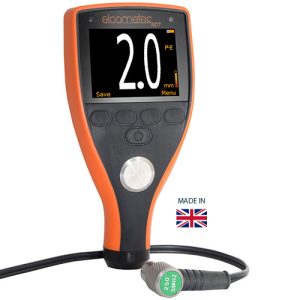
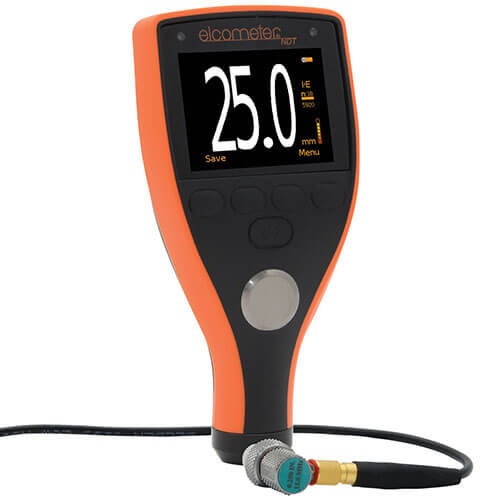
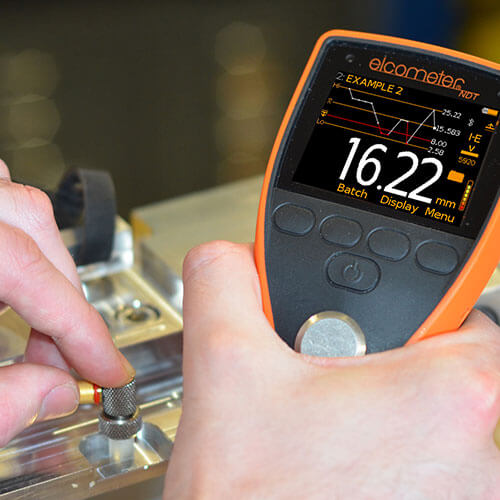
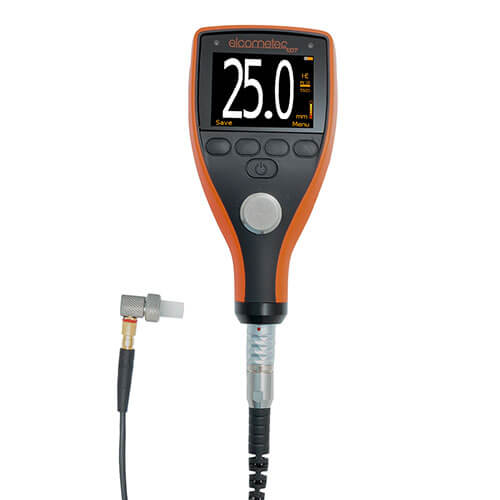
The Elcometer PTG6 Ultrasonic Precision Thickness Gauge is designed for high-accuracy measurement of thin materials when access is available from only one side. Using a high-frequency single-element ultrasonic transducer, it can measure materials as thin as 0.15mm (0.006 in), making it especially useful for precision inspection of thin metals, plastics, and other components where conventional callipers or micrometers cannot be used.
Three measurement modes—Interface Echo, Echo-Echo, and Plastic Mode—allow the PTG6 to adapt to different material thicknesses and acoustic properties. Multiple calibration methods, selectable reading resolution, automatic transducer recognition, and Scan Mode provide greater control when inspecting small, thin, or intricate components.
Measure Materials as Thin as 0.15mm
Echo-Echo Mode provides a measurement range of 0.15–10.15mm (0.006–0.400 in), while Plastic Mode covers 0.15–5.00mm (0.006–0.197 in). This very low minimum thickness makes the PTG6 particularly useful where conventional ultrasonic corrosion gauges may not provide sufficient thin-material capability.
Calibration Options
The PTG6 has a number of calibration options. Using an uncoated sample of test material of a known thickness, the gauge can be calibrated using 1-Point calibration. Alternatively, the user can select one of 39 pre-set materials stored within the gauge including: aluminum, steel, stainless steel, cast iron, plexiglass, PVC, polystyrene and polyurethane.
The PTG6 also offers the additional calibration options of 2-Point & Velocity.
Data Output
Compatible with ElcoMaster® software, individual readings can be downloaded via USB to PC or similar device for further analysis.
Is PTG6 right for my project? |
|
|
Part Number (with Transducer)1 |
PTG6-TXC |
|
Part Number (gauge only) |
PTG6 |
|
Easy to use menu structure in multiple languages |
■ |
|
Tough, impact, waterproof and dust resistant equivalent to IP54 |
■ |
|
Bright colour screen with permanent backlight |
■ |
|
Ambient light sensor, with adjustable brightness |
■ |
|
Scratch and solvent resistant display; 2.4″ (6cm) TFT |
■ |
|
Large positive feedback buttons |
■ |
|
USB power supply via PC |
■ |
|
Gauge software updates2 via ElcoMaster® Software |
■ |
|
2 year gauge warranty3 |
■ |
|
Measurement Mode |
|
|
Echo-Echo (E-E) |
■ |
|
Interface Echo (I-E) |
■ |
|
Plastic Mode (PLAS) |
■ |
|
Measurement Rate |
4, 8, 16Hz4 |
|
Thickness Range5 |
|
|
E-E 0.15 – 10.15mm (0.006-0.400″) |
■ |
|
I-E 1.65 – 25.40mm (0.065-1.000″) |
■ |
|
PLAS 0.15 – 5.00mm (0.006-0.197″) |
■ |
|
Measurement Accuracy6 |
±1% or ±0.015mm (0.0006″) |
|
Measurement Units |
mm or inches |
|
Repeatability / Stability Indicator |
■ |
|
Display Mode: Reading |
■ |
|
Selectable Reading Resolution |
|
|
Lo; ie 0.1mm, 0.01 Inch, 10m/s, or 0.001 in/μs |
■ |
|
Hi; i.e. 0.01mm, 0.001 Inch, 1m/s, or 0.0001 in/μs |
■ |
|
Calibration Options |
|
|
1 – point |
■ |
| 2 – point |
■ |
|
Material selection; 39 preset materials |
■ |
|
Factory; resets to the factory calibration |
■ |
| Velocity (speed of sound) |
■ |
|
Calibration Features |
|
| Calibration lock: with optional PIN Lock |
■ |
| Test calibration feature |
■ |
|
Data Output |
|
|
USB; to PC |
■ |
|
ElcoMaster® software |
■ |
|
Transducer Probe Type |
Single element |
|
Auto transducer recognition |
■ |
|
Battery Type7 |
2 x AA |
|
Battery Life7 |
Alkaline: 15 hours |
|
Operating Temperature |
-10 to 50°C (14 to 122°F) |
|
Size (w x h x d) |
145x73x37mm (5.7×2.84×1.46″) |
|
Weight (including batteries) |
210g (7.4oz) |
|
Packing List |
Elcometer PTG6, 15MHz 1/4″ Microdot right angle single element transducer, couplant, wrist harness, 3 x screen protector, protective case, plastic transit case, 2 x AA batteries, calibration certificate, two year warranty extension card, operating instructions
|
1 Supplied with 15MHz 1/4″Microdot right angle single element transducer
2 Internet connection required
3 The Elcometer MTG range is extendable within 60 days from date of purchase, free of charge to two years
4 User selectable default setting in scan mode is 16 Hz
5 Dependent on the material being measured and the transducer being used
6 Whichever is the greater
7 Supplied with Alkaline, Lithium and rechargable can be used with the gauges, continuous use at 1 reading per second
Product Accessories
|
|
|
|
|
Suitable for measuring |
Suitable for |
|||
|
Part Number |
Probe |
Probe |
Damping |
Thin |
Steel |
Aluminium |
Titanium |
307 |
|
15.0 MHz Single Element Transducer |
||||||||
|
TXC15M0CM |
1/4″ |
Right Angle |
S |
■ |
■ |
■ |
■ |
■ |
|
20.0 MHz Single Element Transducer |
||||||||
|
TXC20M0CM |
1/4″ |
Right Angle |
S |
■ |
■ |
■ |
■ |
■ |
Interface Echo for Thicker Materials
Interface Echo Mode extends the measurement range from 1.65 to 25.40mm (0.065–1.000in). This gives the PTG6 flexibility to handle both very thin materials and thicker precision components with the same instrument, depending on the selected mode and transducer.
Dedicated Plastic Measurement Mode
Plastic Mode is specifically designed for very thin plastic materials between 0.15 and 5.00mm. A graphite delay line is used with this mode to improve measurement performance on thin plastics where conventional ultrasonic techniques can be difficult to apply.
Multiple Calibration Methods for Better Accuracy
The PTG6 offers 1-point and 2-point calibration, velocity calibration, factory calibration, and selection from 39 pre-programmed material velocities. When a reference sample of known thickness is available, calibration can be matched directly to the actual material being inspected rather than relying solely on a generic material setting.
39 Built-In Material Presets
Common materials including steel, stainless steel, aluminium, cast iron, Plexiglas, PVC, polystyrene, and polyurethane can be selected directly from the gauge. These presets simplify setup when the material type is known and a dedicated calibration sample is not available.
Selectable Measurement Resolution
The operator can select between standard and high-resolution display settings. Metric readings can be displayed to either 0.1mm or 0.01mm, allowing the gauge to provide greater numerical detail when inspecting thin precision components.
Scan at Up to 16 Readings per Second
Selectable measurement rates of 4, 8, or 16 readings per second allow the PTG6 to be adapted to the inspection task. Scan Mode is particularly useful when moving the transducer across a component to identify local thickness variations rather than measuring only isolated points.
Automatic Transducer Recognition
The PTG6 automatically recognizes compatible single-element transducers, helping reduce setup errors when probes are changed. Different high-frequency transducers and delay lines can be selected according to the material, geometry, and expected thickness range.
Repeatability and Stability Feedback
A repeatability and stability indicator helps the operator judge whether the ultrasonic signal is producing a consistent measurement. This is valuable when inspecting thin materials where small changes in probe position, surface condition, couplant, or geometry can influence the reading.
USB Transfer to ElcoMaster®
Individual PTG6 readings can be transferred by USB to ElcoMaster® software for further analysis and reporting. This provides a straightforward way to incorporate precision thickness measurements into electronic inspection records without requiring the extensive onboard data-logging functions of the PTG8.
Built for Field and Laboratory Inspection
The gauge features a bright 2.4-inch colour TFT display with permanent backlighting, adjustable brightness, and a scratch- and solvent-resistant screen. Its impact-resistant, dust- and water-resistant housing is rated to the equivalent of IP54, allowing the instrument to be used for both laboratory measurement and industrial inspection.
Supplied with a 15MHz Precision Transducer
The PTG6-TXC package includes a 15MHz ¼-inch right-angle single-element transducer, ultrasonic couplant, wrist harness, screen protectors, batteries, carrying case, calibration certificate, and operating instructions. A 20MHz compatible transducer is also available for applications requiring alternative thin-material performance.
Frequently Asked Questions
Why is the PTG6 better suited to thin materials than a standard ultrasonic corrosion gauge?
The PTG6 uses high-frequency single-element transducers and specialized measurement modes designed specifically for precision measurements on thin materials. Echo-Echo and Plastic Mode can measure down to 0.15mm, substantially thinner than the minimum range of many general-purpose corrosion gauges.
When should I use Interface Echo instead of Echo-Echo?
Interface Echo is intended for materials within the thicker 1.65–25.40mm range, while Echo-Echo is optimized for thinner materials from 0.15–10.15mm. The correct mode depends on material thickness, acoustic properties, transducer, and inspection setup.
What is Plastic Mode and why is it different?
Plastic Mode is optimized specifically for very thin plastics between 0.15 and 5.00mm. Plastics can have different acoustic characteristics from metals, so this dedicated mode and its graphite delay line help improve measurement performance on these materials.
When should I use 2-point calibration instead of 1-point calibration?
One-point calibration is convenient when a representative sample of known thickness is available. Two-point calibration uses two known thicknesses and can improve measurement accuracy across a wider thickness range, particularly when the inspection covers components that vary significantly in thickness.
Why does ultrasonic velocity matter when measuring material thickness?
The gauge calculates thickness from the travel time of an ultrasonic pulse and the speed of sound through the material. If the selected velocity does not match the actual material, the calculated thickness will be incorrect. Material presets or calibration against a known sample help minimize this source of error.
Can the PTG6 measure coated materials through the coating?
The PTG6 is designed primarily for precision measurement of uncoated thin materials. It should not be confused with Elcometer MTG gauges that provide Echo-Echo ThruPaint™ functionality specifically intended to exclude a coating from the underlying wall-thickness measurement.
Why is a delay line used with thin-material ultrasonic measurement?
On very thin materials, the ultrasonic echoes occur extremely close together in time. A delay line separates the transducer excitation from the returning measurement echoes, helping the gauge resolve very small material thicknesses more accurately.
How does Scan Mode help when inspecting thin components?
Scan Mode allows the transducer to be moved across the surface while readings are taken rapidly at up to 16Hz. This can reveal localized variations or minimum-thickness areas that could be missed when only a few isolated measurements are taken.
When should I choose the PTG8 instead of the PTG6?
The PTG6 is well suited to precision point measurement and scanning of thin materials. The PTG8 is the better choice when the inspection also requires extensive onboard data logging, grid batching, advanced graphical displays, limits, statistics, Bluetooth® connectivity, or more comprehensive reporting functions.
Measure Very Thin Materials Accurately When Mechanical Gauges Cannot Reach Both Sides
The Elcometer PTG6 Ultrasonic Precision Thickness Gauge is designed for high-accuracy measurement of thin materials when access is available from only one side. Using a high-frequency single-element ultrasonic transducer, it can measure materials as thin as 0.15mm (0.006 in), making it especially useful for precision inspection of thin metals, plastics, and other components where conventional callipers or micrometers cannot be used.
Three measurement modes—Interface Echo, Echo-Echo, and Plastic Mode—allow the PTG6 to adapt to different material thicknesses and acoustic properties. Multiple calibration methods, selectable reading resolution, automatic transducer recognition, and Scan Mode provide greater control when inspecting small, thin, or intricate components.
Measure Materials as Thin as 0.15mm
Echo-Echo Mode provides a measurement range of 0.15–10.15mm (0.006–0.400 in), while Plastic Mode covers 0.15–5.00mm (0.006–0.197 in). This very low minimum thickness makes the PTG6 particularly useful where conventional ultrasonic corrosion gauges may not provide sufficient thin-material capability.
Calibration Options
The PTG6 has a number of calibration options. Using an uncoated sample of test material of a known thickness, the gauge can be calibrated using 1-Point calibration. Alternatively, the user can select one of 39 pre-set materials stored within the gauge including: aluminum, steel, stainless steel, cast iron, plexiglass, PVC, polystyrene and polyurethane.
The PTG6 also offers the additional calibration options of 2-Point & Velocity.
Data Output
Compatible with ElcoMaster® software, individual readings can be downloaded via USB to PC or similar device for further analysis.
Is PTG6 right for my project? |
|
|
Part Number (with Transducer)1 |
PTG6-TXC |
|
Part Number (gauge only) |
PTG6 |
|
Easy to use menu structure in multiple languages |
■ |
|
Tough, impact, waterproof and dust resistant equivalent to IP54 |
■ |
|
Bright colour screen with permanent backlight |
■ |
|
Ambient light sensor, with adjustable brightness |
■ |
|
Scratch and solvent resistant display; 2.4″ (6cm) TFT |
■ |
|
Large positive feedback buttons |
■ |
|
USB power supply via PC |
■ |
|
Gauge software updates2 via ElcoMaster® Software |
■ |
|
2 year gauge warranty3 |
■ |
|
Measurement Mode |
|
|
Echo-Echo (E-E) |
■ |
|
Interface Echo (I-E) |
■ |
|
Plastic Mode (PLAS) |
■ |
|
Measurement Rate |
4, 8, 16Hz4 |
|
Thickness Range5 |
|
|
E-E 0.15 – 10.15mm (0.006-0.400″) |
■ |
|
I-E 1.65 – 25.40mm (0.065-1.000″) |
■ |
|
PLAS 0.15 – 5.00mm (0.006-0.197″) |
■ |
|
Measurement Accuracy6 |
±1% or ±0.015mm (0.0006″) |
|
Measurement Units |
mm or inches |
|
Repeatability / Stability Indicator |
■ |
|
Display Mode: Reading |
■ |
|
Selectable Reading Resolution |
|
|
Lo; ie 0.1mm, 0.01 Inch, 10m/s, or 0.001 in/μs |
■ |
|
Hi; i.e. 0.01mm, 0.001 Inch, 1m/s, or 0.0001 in/μs |
■ |
|
Calibration Options |
|
|
1 – point |
■ |
| 2 – point |
■ |
|
Material selection; 39 preset materials |
■ |
|
Factory; resets to the factory calibration |
■ |
| Velocity (speed of sound) |
■ |
|
Calibration Features |
|
| Calibration lock: with optional PIN Lock |
■ |
| Test calibration feature |
■ |
|
Data Output |
|
|
USB; to PC |
■ |
|
ElcoMaster® software |
■ |
|
Transducer Probe Type |
Single element |
|
Auto transducer recognition |
■ |
|
Battery Type7 |
2 x AA |
|
Battery Life7 |
Alkaline: 15 hours |
|
Operating Temperature |
-10 to 50°C (14 to 122°F) |
|
Size (w x h x d) |
145x73x37mm (5.7×2.84×1.46″) |
|
Weight (including batteries) |
210g (7.4oz) |
|
Packing List |
Elcometer PTG6, 15MHz 1/4″ Microdot right angle single element transducer, couplant, wrist harness, 3 x screen protector, protective case, plastic transit case, 2 x AA batteries, calibration certificate, two year warranty extension card, operating instructions
|
1 Supplied with 15MHz 1/4″Microdot right angle single element transducer
2 Internet connection required
3 The Elcometer MTG range is extendable within 60 days from date of purchase, free of charge to two years
4 User selectable default setting in scan mode is 16 Hz
5 Dependent on the material being measured and the transducer being used
6 Whichever is the greater
7 Supplied with Alkaline, Lithium and rechargable can be used with the gauges, continuous use at 1 reading per second
Product Accessories
|
|
|
|
|
Suitable for measuring |
Suitable for |
|||
|
Part Number |
Probe |
Probe |
Damping |
Thin |
Steel |
Aluminium |
Titanium |
307 |
|
15.0 MHz Single Element Transducer |
||||||||
|
TXC15M0CM |
1/4″ |
Right Angle |
S |
■ |
■ |
■ |
■ |
■ |
|
20.0 MHz Single Element Transducer |
||||||||
|
TXC20M0CM |
1/4″ |
Right Angle |
S |
■ |
■ |
■ |
■ |
■ |
Interface Echo for Thicker Materials
Interface Echo Mode extends the measurement range from 1.65 to 25.40mm (0.065–1.000in). This gives the PTG6 flexibility to handle both very thin materials and thicker precision components with the same instrument, depending on the selected mode and transducer.
Dedicated Plastic Measurement Mode
Plastic Mode is specifically designed for very thin plastic materials between 0.15 and 5.00mm. A graphite delay line is used with this mode to improve measurement performance on thin plastics where conventional ultrasonic techniques can be difficult to apply.
Multiple Calibration Methods for Better Accuracy
The PTG6 offers 1-point and 2-point calibration, velocity calibration, factory calibration, and selection from 39 pre-programmed material velocities. When a reference sample of known thickness is available, calibration can be matched directly to the actual material being inspected rather than relying solely on a generic material setting.
39 Built-In Material Presets
Common materials including steel, stainless steel, aluminium, cast iron, Plexiglas, PVC, polystyrene, and polyurethane can be selected directly from the gauge. These presets simplify setup when the material type is known and a dedicated calibration sample is not available.
Selectable Measurement Resolution
The operator can select between standard and high-resolution display settings. Metric readings can be displayed to either 0.1mm or 0.01mm, allowing the gauge to provide greater numerical detail when inspecting thin precision components.
Scan at Up to 16 Readings per Second
Selectable measurement rates of 4, 8, or 16 readings per second allow the PTG6 to be adapted to the inspection task. Scan Mode is particularly useful when moving the transducer across a component to identify local thickness variations rather than measuring only isolated points.
Automatic Transducer Recognition
The PTG6 automatically recognizes compatible single-element transducers, helping reduce setup errors when probes are changed. Different high-frequency transducers and delay lines can be selected according to the material, geometry, and expected thickness range.
Repeatability and Stability Feedback
A repeatability and stability indicator helps the operator judge whether the ultrasonic signal is producing a consistent measurement. This is valuable when inspecting thin materials where small changes in probe position, surface condition, couplant, or geometry can influence the reading.
USB Transfer to ElcoMaster®
Individual PTG6 readings can be transferred by USB to ElcoMaster® software for further analysis and reporting. This provides a straightforward way to incorporate precision thickness measurements into electronic inspection records without requiring the extensive onboard data-logging functions of the PTG8.
Built for Field and Laboratory Inspection
The gauge features a bright 2.4-inch colour TFT display with permanent backlighting, adjustable brightness, and a scratch- and solvent-resistant screen. Its impact-resistant, dust- and water-resistant housing is rated to the equivalent of IP54, allowing the instrument to be used for both laboratory measurement and industrial inspection.
Supplied with a 15MHz Precision Transducer
The PTG6-TXC package includes a 15MHz ¼-inch right-angle single-element transducer, ultrasonic couplant, wrist harness, screen protectors, batteries, carrying case, calibration certificate, and operating instructions. A 20MHz compatible transducer is also available for applications requiring alternative thin-material performance.
Frequently Asked Questions
Why is the PTG6 better suited to thin materials than a standard ultrasonic corrosion gauge?
The PTG6 uses high-frequency single-element transducers and specialized measurement modes designed specifically for precision measurements on thin materials. Echo-Echo and Plastic Mode can measure down to 0.15mm, substantially thinner than the minimum range of many general-purpose corrosion gauges.
When should I use Interface Echo instead of Echo-Echo?
Interface Echo is intended for materials within the thicker 1.65–25.40mm range, while Echo-Echo is optimized for thinner materials from 0.15–10.15mm. The correct mode depends on material thickness, acoustic properties, transducer, and inspection setup.
What is Plastic Mode and why is it different?
Plastic Mode is optimized specifically for very thin plastics between 0.15 and 5.00mm. Plastics can have different acoustic characteristics from metals, so this dedicated mode and its graphite delay line help improve measurement performance on these materials.
When should I use 2-point calibration instead of 1-point calibration?
One-point calibration is convenient when a representative sample of known thickness is available. Two-point calibration uses two known thicknesses and can improve measurement accuracy across a wider thickness range, particularly when the inspection covers components that vary significantly in thickness.
Why does ultrasonic velocity matter when measuring material thickness?
The gauge calculates thickness from the travel time of an ultrasonic pulse and the speed of sound through the material. If the selected velocity does not match the actual material, the calculated thickness will be incorrect. Material presets or calibration against a known sample help minimize this source of error.
Can the PTG6 measure coated materials through the coating?
The PTG6 is designed primarily for precision measurement of uncoated thin materials. It should not be confused with Elcometer MTG gauges that provide Echo-Echo ThruPaint™ functionality specifically intended to exclude a coating from the underlying wall-thickness measurement.
Why is a delay line used with thin-material ultrasonic measurement?
On very thin materials, the ultrasonic echoes occur extremely close together in time. A delay line separates the transducer excitation from the returning measurement echoes, helping the gauge resolve very small material thicknesses more accurately.
How does Scan Mode help when inspecting thin components?
Scan Mode allows the transducer to be moved across the surface while readings are taken rapidly at up to 16Hz. This can reveal localized variations or minimum-thickness areas that could be missed when only a few isolated measurements are taken.
When should I choose the PTG8 instead of the PTG6?
The PTG6 is well suited to precision point measurement and scanning of thin materials. The PTG8 is the better choice when the inspection also requires extensive onboard data logging, grid batching, advanced graphical displays, limits, statistics, Bluetooth® connectivity, or more comprehensive reporting functions.