 0 items
Measure Material and Wall Thickness from One Side
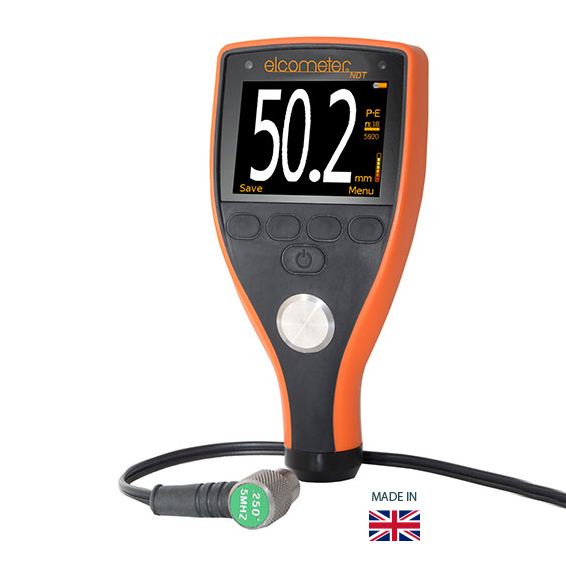
The Elcometer MTG4 Ultrasonic Material Thickness Gauge provides fast, non-destructive measurement of material thickness when access is available from only one side of the test piece. It is ideal for inspecting pipes, tanks, vessels, structural components and other metal or non-metal materials where mechanical thickness measurement is impractical.
With a choice of calibration methods and measurement modes, the MTG4 can be used on a wide range of coated and uncoated materials. It combines conventional Pulse-Echo measurement with Elcometer’s Echo-Echo ThruPaint™ mode, which can determine the underlying material thickness without including the coating thickness in the result.
Pulse-Echo Measurement for Material Thickness and Corrosion Inspection
In Pulse-Echo (P-E) mode, the gauge measures from the base of the transducer to the material density boundary, normally the back wall of the component. This mode is particularly useful for general wall-thickness measurement and for identifying material loss associated with corrosion, pitting and flaws. The MTG4 has a Pulse-Echo measurement range of 0.63 to 500 mm (0.025 to 19.999 in), depending on the material and transducer used.
Echo-Echo ThruPaint™ Measurement on Coated Surfaces
Removing a protective coating simply to obtain an ultrasonic thickness measurement can add time and potentially damage the coating system. The MTG4’s Echo-Echo ThruPaint™ (E-E) mode is designed to measure the underlying material while ignoring the coating thickness.
This makes the MTG4 particularly useful for inspecting coated steel structures, tanks and pipework where the inspector needs to determine the remaining substrate thickness without unnecessarily removing the protective coating. A suitable highly damped coating-thickness transducer is required for Echo-Echo ThruPaint™ measurements.
Factory Calibrated for 39 Materials
The Elcometer MTG4 includes 39 pre-set material calibrations, allowing the operator to select the material being inspected rather than manually determining its ultrasonic velocity. Pre-set materials include commonly tested substrates such as:
- Steel
- Stainless steel
- Aluminium
- Cast iron
- Plexiglass
- PVC
- Polystyrene
- Polyurethane
This built-in material library simplifies setup when inspecting known materials and helps reduce the possibility of errors caused by entering an incorrect sound velocity.
1-Point Calibration for Known Materials
When an uncoated sample of the test material with a known thickness is available, the MTG4 can also be configured using 1-Point calibration. This allows the gauge to be calibrated directly to the material being inspected for reliable thickness measurements.
The combination of pre-set material calibration and 1-Point calibration makes the MTG4 more adaptable when moving between different inspection applications.
Velocity Mode for Materials with a Known Thickness
The MTG4 also provides Velocity Mode (VM), with an ultrasonic velocity range of 1,250 to 10,000 m/s (0.0492 to 0.3937 in/µs). This allows the material’s sound velocity to be determined when its thickness is known, providing additional flexibility for material identification and gauge setup.
Clear Colour Display for Field Inspection
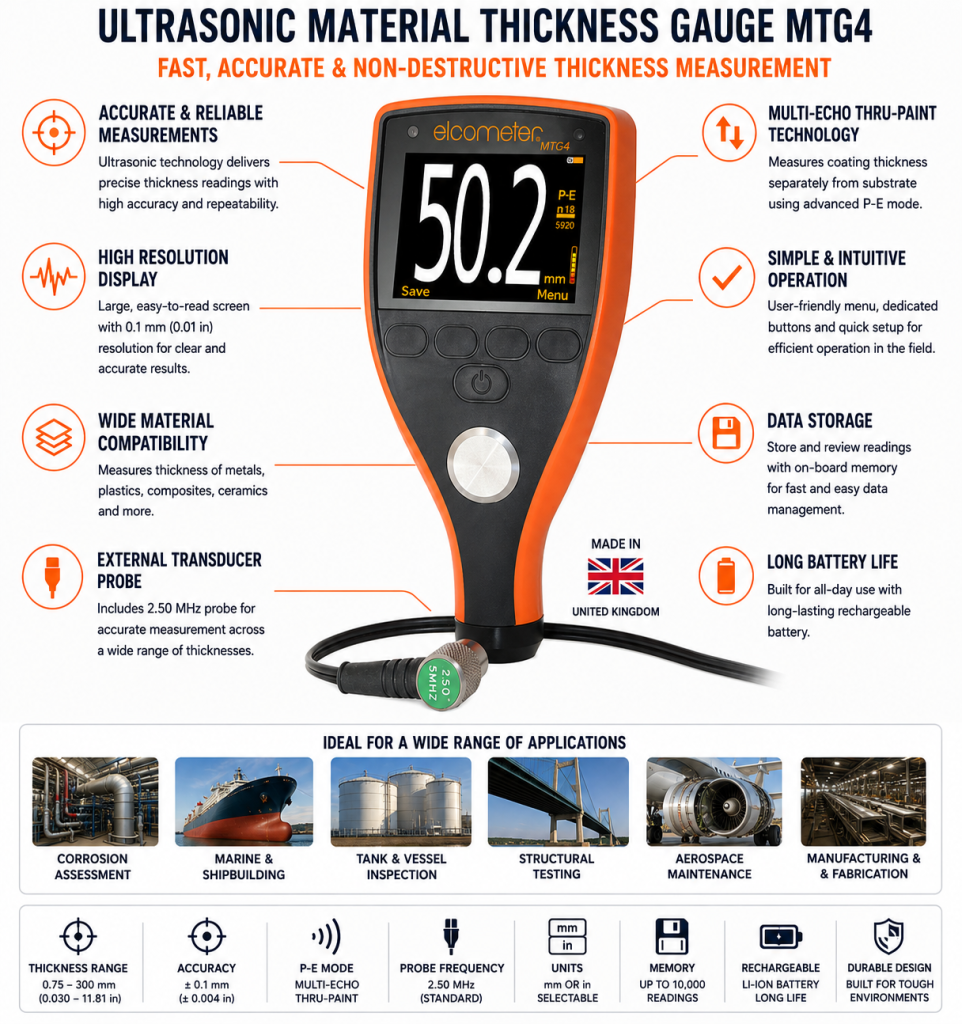
The MTG4 features a bright 2.4 in (6 cm) colour TFT display with permanent backlighting. An ambient light sensor and adjustable brightness help keep measurement information clearly visible under changing inspection conditions.
The scratch- and solvent-resistant display, large positive-feedback buttons and multilingual menu structure are designed for practical use in industrial environments.
Rugged Construction for Industrial Environments
Designed for demanding inspection work, the Elcometer MTG4 is tough, impact resistant, waterproof and dust resistant to an equivalent of IP64. Its compact handheld design makes it suitable for routine field measurements on pipelines, storage tanks, fabricated structures and industrial equipment.
The gauge operates between -10°C and 50°C (14°F to 122°F) and is powered by two AA batteries, making replacement power readily available during field work.
MTG4 and MTG4-TXC Versions
The Elcometer MTG4 is available either as the MTG4 gauge only or as the MTG4-TXC package. The MTG4-TXC version includes a 5 MHz, ¼ in right-angle dual-element transducer, allowing the instrument to be purchased as a ready-to-use ultrasonic thickness measurement package.
A wide selection of alternative Elcometer ultrasonic transducers is available for different materials, thickness ranges and inspection applications.
Key Features
- Non-destructive ultrasonic material thickness measurement
- Requires access to only one side of the test material
- Pulse-Echo mode for general thickness, pit and flaw inspection
- Echo-Echo ThruPaint™ mode measures substrate thickness through coatings
- Pulse-Echo measurement range: 0.63 – 500 mm (0.025 – 19.999 in)
- Echo-Echo ThruPaint™ measurement range: 2.54 – 20.00 mm (0.100 – 0.787 in)
- Factory calibrated for 39 different materials
- 1-Point calibration using a known-thickness sample
- Velocity Mode range: 1,250 – 10,000 m/s
- Suitable for a wide range of coated and uncoated materials
- Bright 2.4 in (6 cm) colour TFT display
- Permanent backlight with ambient light sensor
- Scratch- and solvent-resistant display
- Multilingual menu structure
- Large positive-feedback buttons
- Impact, water and dust resistant to an equivalent of IP64
- USB power supply via PC
- Gauge software can be updated using ElcoMaster®
- Calibration certificate supplied as standard
Technical Specifications
| Product | Elcometer MTG4 Ultrasonic Material Thickness Gauge |
|---|---|
| Gauge Only Part Number | MTG4 |
| Gauge & Transducer Part Number | MTG4-TXC |
| Pulse-Echo (P-E) Range | 0.63 – 500 mm (0.025 – 19.999 in) |
| Echo-Echo ThruPaint™ (E-E) Range | 2.54 – 20.00 mm (0.100 – 0.787 in) |
| Velocity Mode | 1,250 – 10,000 m/s (0.0492 – 0.3937 in/µs) |
| Pulse-Echo Accuracy | ±0.1 mm from 0.63 – 19.99 mm; ±0.5% from 20.00 – 500.00 mm |
| Echo-Echo Accuracy | ±0.1 mm from 2.54 – 25.4 mm |
| Pre-Set Materials | 39 |
| Display | 2.4 in (6 cm) colour TFT |
| Environmental Protection | Water and dust resistant, equivalent to IP64 |
| Operating Temperature | -10°C to 50°C (14°F to 122°F) |
| Power Supply | 2 × AA batteries |
| Battery Life | Approximately 15 hours with alkaline batteries; 28 hours with lithium batteries |
| Gauge Dimensions | 145 × 73 × 37 mm (5.7 × 2.84 × 1.46 in), without transducer |
| Gauge Weight | 210 g (7.4 oz), including batteries and without transducer |
MTG4-TXC Package
The MTG4-TXC configuration includes the 5 MHz, ¼ in right-angle dual-element transducer. The standard package includes:
- Elcometer MTG4 Ultrasonic Material Thickness Gauge
- 5 MHz, ¼ in right-angle dual-element transducer
- Ultrasonic couplant
- Carry pouch
- Screen protector
- Wrist harness
- 2 × AA batteries
- Operating instructions
- Test certificate
- Warranty extension card
Compatible Standards
The Elcometer MTG range is designed for ultrasonic material thickness measurement in accordance with recognised test methods including:
- ASTM E797
- EN 14127
- EN 15317
Delay Lines
Each gauge is supplied with 9mm and 12mm acrylic delay lines suitable for measuring on steel, aluminum and titanium.
If measuring on thin plastics using Plastic Mode (PLAS), a graphite delay line must be used. These are available to purchase as optional accessories.Part NumberDescriptionT92016528Acrylic Delay Line; 1/4 Dia x 9mmT92016529Acrylic Delay Line; 1/4 Dia x 12mmT92023853-4Graphite Delay Line; 1/4 Dia x 3/16″All transducers are supplied with a calibration certificate
HD—Highly damped Transducer
CT—Damped Coating Thickness Transducer
S—–Standard undamped Transducer
STANDARDS MTG: ASTM E797, EN 14127, EN15317STANDARDS PTG: EN14127, EN15317
Q&A
Can the MTG4 measure the wall thickness of a pipe from the outside?
Yes. Ultrasonic measurement requires access to only one side of the component, making the MTG4 particularly useful for checking pipe and vessel wall thickness when the opposite surface cannot be reached.
Do I need to remove paint before taking a thickness measurement?
Not necessarily. The MTG4’s Echo-Echo ThruPaint™ mode is designed to ignore the coating and measure the underlying material thickness. A suitable highly damped coating-thickness transducer is required for this mode.
What is the difference between Pulse-Echo and Echo-Echo ThruPaint™?
Pulse-Echo measures the total distance from the base of the transducer to the material’s back wall and is useful for general thickness, pit and flaw inspection. Echo-Echo ThruPaint™ eliminates the coating thickness from the result so the underlying material thickness can be measured through a coated surface.
What is the difference between MTG4 and MTG4-TXC?
MTG4 refers to the gauge-only configuration. MTG4-TXC includes the MTG4 gauge together with a 5 MHz, ¼ in right-angle dual-element transducer.
Why are the 39 pre-set materials useful?
Ultrasonic thickness measurement depends on the speed of sound through the material being tested. Selecting a known material from the MTG4’s built-in library automatically applies the appropriate factory calibration, simplifying setup for commonly inspected materials.
Can the MTG4 be calibrated to a specific material?
Yes. If an uncoated sample of the same material with a known thickness is available, the MTG4’s 1-Point calibration can be used to calibrate the gauge directly to that material.
Is couplant required for ultrasonic measurements?
Yes. Ultrasonic couplant is used between the transducer and test surface to provide effective transmission of the ultrasonic signal into the material. Couplant is included with the standard MTG4 package.
Is the MTG4 suitable for corrosion inspection?
Yes. Pulse-Echo measurement can be used to determine remaining material thickness and is useful for identifying areas affected by corrosion, pitting or other material loss when the surface and geometry are suitable for ultrasonic testing.
Measure Material and Wall Thickness from One Side
The Elcometer MTG4 Ultrasonic Material Thickness Gauge provides fast, non-destructive measurement of material thickness when access is available from only one side of the test piece. It is ideal for inspecting pipes, tanks, vessels, structural components and other metal or non-metal materials where mechanical thickness measurement is impractical.
With a choice of calibration methods and measurement modes, the MTG4 can be used on a wide range of coated and uncoated materials. It combines conventional Pulse-Echo measurement with Elcometer’s Echo-Echo ThruPaint™ mode, which can determine the underlying material thickness without including the coating thickness in the result.
Pulse-Echo Measurement for Material Thickness and Corrosion Inspection
In Pulse-Echo (P-E) mode, the gauge measures from the base of the transducer to the material density boundary, normally the back wall of the component. This mode is particularly useful for general wall-thickness measurement and for identifying material loss associated with corrosion, pitting and flaws. The MTG4 has a Pulse-Echo measurement range of 0.63 to 500 mm (0.025 to 19.999 in), depending on the material and transducer used.
Echo-Echo ThruPaint™ Measurement on Coated Surfaces
Removing a protective coating simply to obtain an ultrasonic thickness measurement can add time and potentially damage the coating system. The MTG4’s Echo-Echo ThruPaint™ (E-E) mode is designed to measure the underlying material while ignoring the coating thickness.
This makes the MTG4 particularly useful for inspecting coated steel structures, tanks and pipework where the inspector needs to determine the remaining substrate thickness without unnecessarily removing the protective coating. A suitable highly damped coating-thickness transducer is required for Echo-Echo ThruPaint™ measurements.
Factory Calibrated for 39 Materials
The Elcometer MTG4 includes 39 pre-set material calibrations, allowing the operator to select the material being inspected rather than manually determining its ultrasonic velocity. Pre-set materials include commonly tested substrates such as:
- Steel
- Stainless steel
- Aluminium
- Cast iron
- Plexiglass
- PVC
- Polystyrene
- Polyurethane
This built-in material library simplifies setup when inspecting known materials and helps reduce the possibility of errors caused by entering an incorrect sound velocity.
1-Point Calibration for Known Materials
When an uncoated sample of the test material with a known thickness is available, the MTG4 can also be configured using 1-Point calibration. This allows the gauge to be calibrated directly to the material being inspected for reliable thickness measurements.
The combination of pre-set material calibration and 1-Point calibration makes the MTG4 more adaptable when moving between different inspection applications.
Velocity Mode for Materials with a Known Thickness
The MTG4 also provides Velocity Mode (VM), with an ultrasonic velocity range of 1,250 to 10,000 m/s (0.0492 to 0.3937 in/µs). This allows the material’s sound velocity to be determined when its thickness is known, providing additional flexibility for material identification and gauge setup.
Clear Colour Display for Field Inspection
The MTG4 features a bright 2.4 in (6 cm) colour TFT display with permanent backlighting. An ambient light sensor and adjustable brightness help keep measurement information clearly visible under changing inspection conditions.
The scratch- and solvent-resistant display, large positive-feedback buttons and multilingual menu structure are designed for practical use in industrial environments.
Rugged Construction for Industrial Environments
Designed for demanding inspection work, the Elcometer MTG4 is tough, impact resistant, waterproof and dust resistant to an equivalent of IP64. Its compact handheld design makes it suitable for routine field measurements on pipelines, storage tanks, fabricated structures and industrial equipment.
The gauge operates between -10°C and 50°C (14°F to 122°F) and is powered by two AA batteries, making replacement power readily available during field work.
MTG4 and MTG4-TXC Versions
The Elcometer MTG4 is available either as the MTG4 gauge only or as the MTG4-TXC package. The MTG4-TXC version includes a 5 MHz, ¼ in right-angle dual-element transducer, allowing the instrument to be purchased as a ready-to-use ultrasonic thickness measurement package.
A wide selection of alternative Elcometer ultrasonic transducers is available for different materials, thickness ranges and inspection applications.
Key Features
- Non-destructive ultrasonic material thickness measurement
- Requires access to only one side of the test material
- Pulse-Echo mode for general thickness, pit and flaw inspection
- Echo-Echo ThruPaint™ mode measures substrate thickness through coatings
- Pulse-Echo measurement range: 0.63 – 500 mm (0.025 – 19.999 in)
- Echo-Echo ThruPaint™ measurement range: 2.54 – 20.00 mm (0.100 – 0.787 in)
- Factory calibrated for 39 different materials
- 1-Point calibration using a known-thickness sample
- Velocity Mode range: 1,250 – 10,000 m/s
- Suitable for a wide range of coated and uncoated materials
- Bright 2.4 in (6 cm) colour TFT display
- Permanent backlight with ambient light sensor
- Scratch- and solvent-resistant display
- Multilingual menu structure
- Large positive-feedback buttons
- Impact, water and dust resistant to an equivalent of IP64
- USB power supply via PC
- Gauge software can be updated using ElcoMaster®
- Calibration certificate supplied as standard
Technical Specifications
| Product | Elcometer MTG4 Ultrasonic Material Thickness Gauge |
|---|---|
| Gauge Only Part Number | MTG4 |
| Gauge & Transducer Part Number | MTG4-TXC |
| Pulse-Echo (P-E) Range | 0.63 – 500 mm (0.025 – 19.999 in) |
| Echo-Echo ThruPaint™ (E-E) Range | 2.54 – 20.00 mm (0.100 – 0.787 in) |
| Velocity Mode | 1,250 – 10,000 m/s (0.0492 – 0.3937 in/µs) |
| Pulse-Echo Accuracy | ±0.1 mm from 0.63 – 19.99 mm; ±0.5% from 20.00 – 500.00 mm |
| Echo-Echo Accuracy | ±0.1 mm from 2.54 – 25.4 mm |
| Pre-Set Materials | 39 |
| Display | 2.4 in (6 cm) colour TFT |
| Environmental Protection | Water and dust resistant, equivalent to IP64 |
| Operating Temperature | -10°C to 50°C (14°F to 122°F) |
| Power Supply | 2 × AA batteries |
| Battery Life | Approximately 15 hours with alkaline batteries; 28 hours with lithium batteries |
| Gauge Dimensions | 145 × 73 × 37 mm (5.7 × 2.84 × 1.46 in), without transducer |
| Gauge Weight | 210 g (7.4 oz), including batteries and without transducer |
MTG4-TXC Package
The MTG4-TXC configuration includes the 5 MHz, ¼ in right-angle dual-element transducer. The standard package includes:
- Elcometer MTG4 Ultrasonic Material Thickness Gauge
- 5 MHz, ¼ in right-angle dual-element transducer
- Ultrasonic couplant
- Carry pouch
- Screen protector
- Wrist harness
- 2 × AA batteries
- Operating instructions
- Test certificate
- Warranty extension card
Compatible Standards
The Elcometer MTG range is designed for ultrasonic material thickness measurement in accordance with recognised test methods including:
- ASTM E797
- EN 14127
- EN 15317
Delay Lines
Each gauge is supplied with 9mm and 12mm acrylic delay lines suitable for measuring on steel, aluminum and titanium.
If measuring on thin plastics using Plastic Mode (PLAS), a graphite delay line must be used. These are available to purchase as optional accessories.Part NumberDescriptionT92016528Acrylic Delay Line; 1/4 Dia x 9mmT92016529Acrylic Delay Line; 1/4 Dia x 12mmT92023853-4Graphite Delay Line; 1/4 Dia x 3/16″All transducers are supplied with a calibration certificate
HD—Highly damped Transducer
CT—Damped Coating Thickness Transducer
S—–Standard undamped Transducer
STANDARDS MTG: ASTM E797, EN 14127, EN15317STANDARDS PTG: EN14127, EN15317
Q&A
Can the MTG4 measure the wall thickness of a pipe from the outside?
Yes. Ultrasonic measurement requires access to only one side of the component, making the MTG4 particularly useful for checking pipe and vessel wall thickness when the opposite surface cannot be reached.
Do I need to remove paint before taking a thickness measurement?
Not necessarily. The MTG4’s Echo-Echo ThruPaint™ mode is designed to ignore the coating and measure the underlying material thickness. A suitable highly damped coating-thickness transducer is required for this mode.
What is the difference between Pulse-Echo and Echo-Echo ThruPaint™?
Pulse-Echo measures the total distance from the base of the transducer to the material’s back wall and is useful for general thickness, pit and flaw inspection. Echo-Echo ThruPaint™ eliminates the coating thickness from the result so the underlying material thickness can be measured through a coated surface.
What is the difference between MTG4 and MTG4-TXC?
MTG4 refers to the gauge-only configuration. MTG4-TXC includes the MTG4 gauge together with a 5 MHz, ¼ in right-angle dual-element transducer.
Why are the 39 pre-set materials useful?
Ultrasonic thickness measurement depends on the speed of sound through the material being tested. Selecting a known material from the MTG4’s built-in library automatically applies the appropriate factory calibration, simplifying setup for commonly inspected materials.
Can the MTG4 be calibrated to a specific material?
Yes. If an uncoated sample of the same material with a known thickness is available, the MTG4’s 1-Point calibration can be used to calibrate the gauge directly to that material.
Is couplant required for ultrasonic measurements?
Yes. Ultrasonic couplant is used between the transducer and test surface to provide effective transmission of the ultrasonic signal into the material. Couplant is included with the standard MTG4 package.
Is the MTG4 suitable for corrosion inspection?
Yes. Pulse-Echo measurement can be used to determine remaining material thickness and is useful for identifying areas affected by corrosion, pitting or other material loss when the surface and geometry are suitable for ultrasonic testing.