 0 items
Combine Advanced Flaw Detection and Material Thickness Measurement in One Handheld Gauge
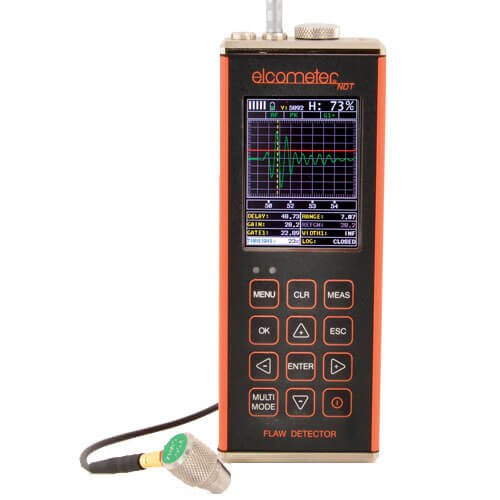
The Elcometer FD700DL+ combines a professional ultrasonic flaw detector with advanced material and coating thickness measurement in a single portable instrument. In flaw detection mode, it can locate, size, and help characterize internal discontinuities in materials and welded joints. Switching to thickness mode provides multiple ultrasonic measurement methods for corrosion assessment, material thickness, and coating measurement.
This dual-purpose design is especially valuable when an inspection requires more than a simple thickness value. A-Scan waveform analysis, DAC, AWS, TCG, AVG/DGS, three adjustable gates, multiple detection methods, and extensive data logging give inspectors detailed control over demanding ultrasonic examinations.
Tool kits include:
- TRIG enabling flaw detection in both surface distance and depth from the transducer.
- DAC for the creation of DAC curves which are used to inform the operator of the size of any given flaw at any depth.
- AWS function provides automatic defect sizing in accordance with AWS D1.1 structural welding code.
- AVG/DGS allows automatic defect sizing using probe data, storing up to 64 custom setups.
- TCG (time corrected gain) increases gain as time increases, in order to achieve an over all level of sensitivity for the same flaw/reflector at different distances.
What makes Elcometer NDT FD700DL+ so efficient
- Exceptional visibility in sunlight (AMOLED) colour VGA display (320×240 pixels)
- Sizing Toolkits: DAC, AWS, TCG, DGS
- P.R.F. 8 to 333 Hz, adjustable
- Screen Refresh Rate: Adjustable 60 & 120 Hz
- Detection: Z-Cross, Flank & Peak
- Automatic: probe zero, probe recognition, and temperature compensation
- Measurement: Variety of modes to address a number of applications
- Large data storage with multiple formats: Alpha numeric grid and sequential w/auto identifier
- Up to 12 hours of battery life
- Data management software
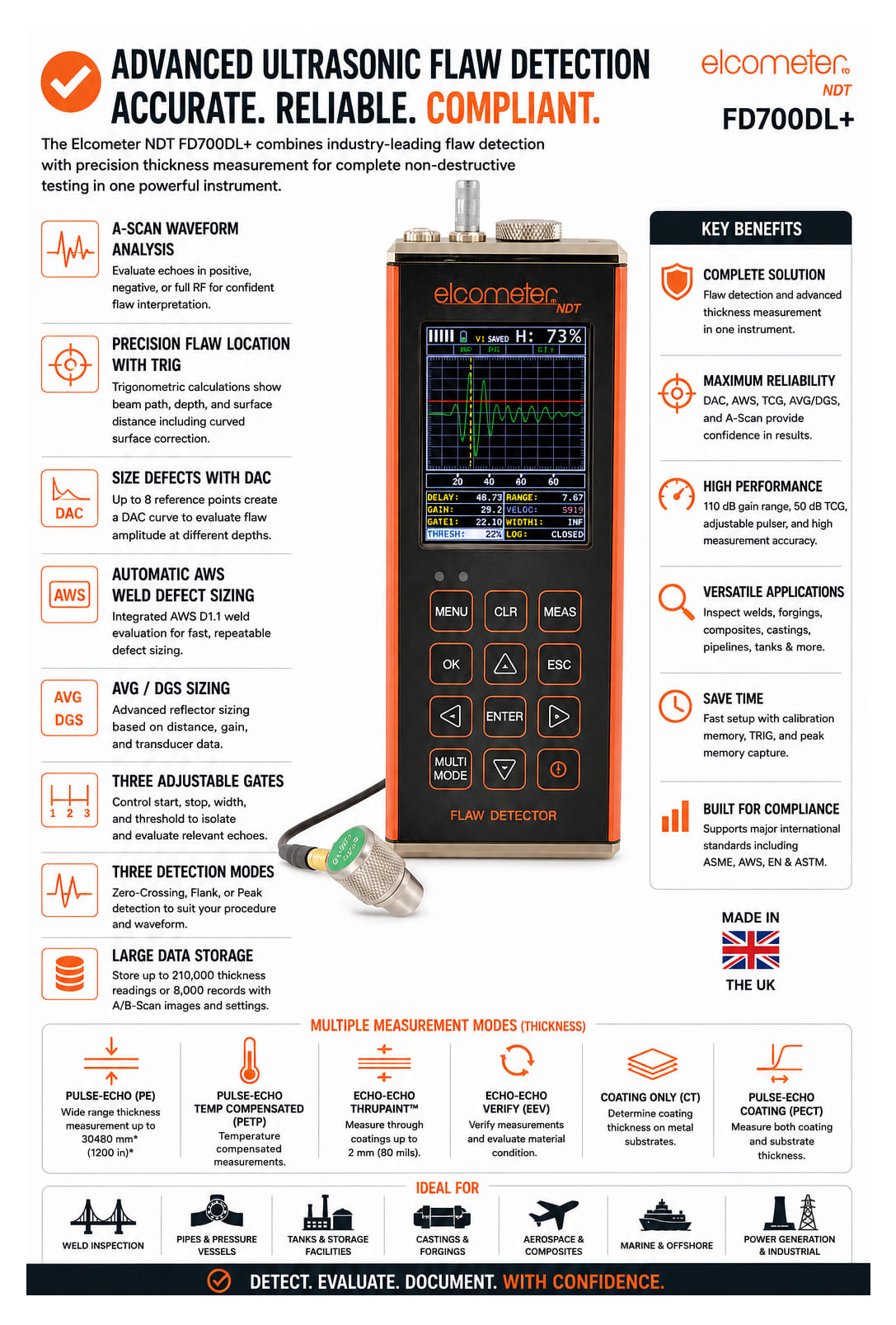
Flaw Detection and Thickness Measurement in One Instrument
The FD700DL+ can operate as either an ultrasonic flaw detector or an advanced thickness gauge. In flaw detection mode, it evaluates the size and position of discontinuities and supports differentiation between flaw types. Thickness mode provides Pulse-Echo, temperature-compensated Pulse-Echo, Echo-Echo ThruPaint™, Echo-Echo Verify, Coating Only, and Pulse-Echo Coating measurement modes.
Analyze Internal Defects with A-Scan
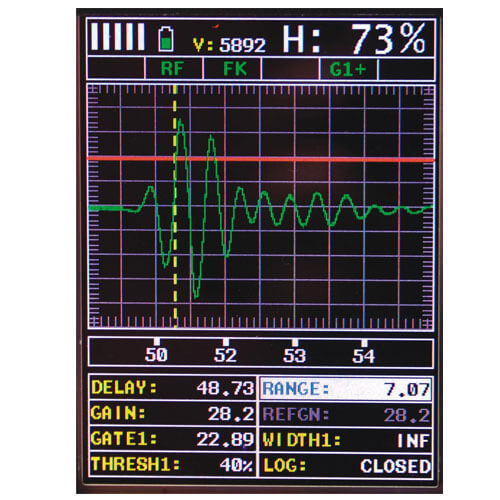
The A-Scan display allows inspectors to examine ultrasonic echoes rather than relying solely on a calculated numerical result. Positive rectified, negative rectified, and full RF waveform displays are available, providing greater insight when evaluating welds, forgings, composites, and other materials where signal interpretation is important.
Locate Flaws with TRIG
TRIG provides trigonometric information when angle-beam transducers are used, including beam path, flaw depth, and surface distance. Curved-surface correction is also available, helping inspectors determine where an indication is located within the test component.
Size Defects with DAC
Distance Amplitude Correction allows up to eight reference points to be entered to create a DAC curve. Indications at different depths can then be compared against the reference response, helping the operator assess flaw amplitude while compensating for changes caused by sound-path distance.
Automatic AWS Weld Defect Sizing
The integrated AWS function provides automatic defect sizing in accordance with AWS D1.1 structural welding procedures. This makes the FD700DL+ particularly useful for ultrasonic weld inspection where AWS-based evaluation is required.
AVG/DGS Defect Sizing
AVG/DGS provides another method for evaluating reflector size using transducer data and the relationship between distance, gain, and equivalent reflector size. Up to 64 custom setups can be stored, allowing frequently used configurations to be recalled for repeated inspection work.
Maintain Sensitivity with Time Corrected Gain
TCG compensates for the reduction in ultrasonic signal amplitude that occurs as sound travels farther through the material. The FD700DL+ provides a 50dB TCG dynamic range with up to eight curve-definition points, helping maintain comparable sensitivity to similar reflectors located at different depths.
Three Fully Adjustable Gates
Three independent gates provide control over start position, stop position, width, and threshold. By restricting evaluation to selected areas of the waveform, inspectors can concentrate on relevant echoes and reduce interference from signals outside the inspection region of interest.
Choose Zero-Crossing, Flank, or Peak Detection
The FD700DL+ offers three detection methods for determining where an ultrasonic indication is measured. Zero-Crossing references the next waveform crossing after the trigger point, Flank detects the side of the pulse, and Peak identifies the signal peak. This allows the detection method to be matched more closely to the inspection procedure and waveform characteristics.
Inspect with Straight, Dual, Delay-Line, or Angle-Beam Probes
The instrument supports single-contact, dual-element, delay-line, and angle-beam transducers. Automatic calibration can be performed for longitudinal straight-beam or shear-wave angle-beam inspection, giving the FD700DL+ flexibility across thickness measurement, corrosion inspection, weld examination, and general flaw detection.
Adjust Gain for Difficult Ultrasonic Signals
Automatic Gain Control and manual gain adjustment provide a 110dB range with 0.2dB resolution. Adjustable damping, pulse width, and pulser settings provide additional control when optimizing transducer performance, penetration, and signal response for different materials.
Capture Peak Indications
Peak Memory records the maximum signal amplitude encountered while scanning. This can help inspectors locate the strongest response from a reflector while moving the transducer, rather than requiring the probe to remain perfectly positioned while the waveform is interpreted.
Store Complete Inspection Records
The FD700DL+ can store up to 210,000 coating, material, minimum, or maximum thickness readings. For more detailed inspections, up to 8,000 records can be retained with A/B-Scan images and gauge settings. Sequential and grid logging, alphanumeric batch identification, and an obstruction function support systematic inspection documentation.
Built for Welds, Forgings, and Composite Inspection
Elcometer identifies weld inspection, forgings, and composite material testing as key applications for the FD700 series. The combination of flaw-sizing toolkits, waveform analysis, angle-beam capability, and thickness measurement also supports ultrasonic NDT work across oil and gas, marine, transportation, power, and civil engineering applications.
| Model & Part Number | FD700DL+ Flaw Detection Gauge |
| Material thickness digits display | – |
| B-Scan cross-sectional display | – |
| B-Scan with digits display | – |
| Scan bar display | – |
| Coating thickness display | – |
| A-Scan display | + Rectified, – Rectified, Full Waveform (RF) |
| Flaw detection modes | TRIG, DAC, AWS, TCG, Zero Crossing, Flank, Peak |
| Measurement Mode | PE, PETP (Temp Compensation), EE (ThruPaint™), EEV, CT (Coating) & PECT |
| Measurement Rate (Thickness Mode) Manual: Scan mode Scan bar display |
4 readings per second 32 readings per second 6 readings per second |
| Measuring Range | PE: 0.63 – 30480mm (0.025 – 1,200 inches) PETP: 0.63 – 30480mm (0.025 – 1,200 inches) EE: 1.27 – 102mm (0.050 – 4.000 inches) EEV: 1.27 – 25.4mm (0.050 – 1.000 inch) CT: 0.01 – 2.54mm (0.0005 – 0.100 inch) PECT: 0.63 – 30480mm (0.025 – 1,200 inches) PECT: 0.01 – 2.54mm (0.0005 – 0.100 inch) |
| Measurement Accuracy | ±0.01mm (±0.001 inch) |
| Measurement Resolution | 0.01mm (0.001 inch) |
| Velocity Calibration Range | 256 – 16,000m/s (0.0100 – 0.6300in/ms) |
| Additional Features: | |
| High speed scan mode | – |
| Differential mode | – |
| Limit alarm mode | – |
| B-Scan display speed | adjustable display speed |
| Calibration setups | 6 factory & 64 user-definable setups transferrable to and from a PC archive |
| Gates | 3 fully adjustable gates: start, stop, width & threshold |
| Damping | adjustable; impedance matching for optimizing transducer performance |
| Pulser type | dual 200 Volt square wave pulsers with adjustable pulse width (spike, thin, wide) and 50 Volt cut/boost for greater penetration |
| Gain | manual, automatic gain control (AGC) with 110dB range with 0.2dB resolution |
| Timing | precision 25MHz TCXO with a single shot 100MHz 8bit ultra-low-power 8-bit digitizer |
| Data logging | – 8,000 with A/B-scan image & gauge settings – 210,000 – coating, material, min, max thickness – sequential and grid logging – Alphanumeric batch identification – OBSTRUCT indicates inaccessible locations |
| Calibration Options | single, two-point, velocity & material type |
| Transducer recognition | automatic |
| V-path / dual path error correction | automatic |
| Probe zero | automatic |
| Flaw Detection Mode Features | |
| Automatic Calibration: |
Longitudinal (straight), or Shear (angle) |
| Probe Types: | Single Contact, Dual, Delay & Angle |
| Material Velocity Table: | Contains longitudinal and shear velocities for a variety of material types |
| TRIG | Trigonometric display of beam path, depth, surface distance, and curved surface correction. Used with angle beam transducers |
| DAC | Up to 8 points may be entered and used to digitally draw a DAC curve. Reference -2, -6, -10, (-6/-12), (-6/-14), (-2/-6/-10) dB. Amplitude displayed in %DAC, dB, or %FSH |
| AWS | Automatic defect sizing in accordance with AWS D1.1 structural welding code. |
| AVG/DGS | Automatic defect sizing using a probe data. Stores up to 64 custom setups |
| TCG | Time corrected gain. 50 dB dynamic range, 20 dB per microsecond, up to 8 points for curve definition |
| Detection Modes | Zero-Crossing, Flank and Peak |
| Display Freeze | Hold current waveform on screen |
| Peak Memory | Captures peak signal amplitude. |
| P.R.F | 8 to 333Hz in selectable steps (8, 16, 32, 66, 125, 250, 333Hz) |
| Pulse Width | 40 to 400 ns. Selectable step options 40, 80 & 400 ns (labeled spike, thin & wide) |
| Frequency Bands | FD700+ & FD700DL+: Broadband 1.8 – 19 MHz (-3dB). FD700DL+: Three narrow bands at 2MHz, 5MHz, 10MHz |
| Horizontal Linearity | +/- 0.4% FSW |
| Vertical Linearity | +/- 1% FSH |
| Amplifier Linearity | +/- 1 dB |
| Amplitude Measurement | 0 to 100% FSH, with 1% resolution |
| Delay | 0 – 999in (25,375mm) at steel velocity |
| Display | 1/4″ VGA AMOLED color display 57.6 x 43.2mm (2.27 x 1.78inch) viewable area |
| Display Refresh Rate | 120Hz |
| Units (selectable) | mm or inches |
| Backlight | adjustable brightness |
| Repeatability / Stability Indicator | – |
| Battery Type | 3 x AA alkaline |
| Battery Life (approximate) |
12 hours |
| Low Battery Indicator | – |
| Battery Save Mode | auto |
| Operating Temperature | -10 to 60ºC (14 to 140ºF) |
| Size (w x h x d) | 63.5 x 165.0 x 31.5mm (2.5 x 6.5 x 1.24 inches) |
| Weight (including batteries) | 397g (14oz) |
| Case Design | Aluminum case design with gasket-sealed end caps, waterproof membrane keypad |
| Transducer Connector Type | LEMO |
| RS232 Interface | Bi-directional |
| Packing List | Elcometer FD700DL+ flaw detection gauge, couplant, carry case, user manual, test certificate, 3 x AA batteries, software, transfer cable |
Frequently Asked Questions
When should I use DAC instead of simply evaluating echo amplitude?
Raw echo amplitude changes as the sound path increases, even when similar reflectors are being inspected. DAC establishes reference amplitudes at different distances, allowing indications to be evaluated relative to a distance-corrected reference rather than comparing raw amplitudes from different depths.
What is the difference between DAC and TCG?
DAC creates reference curves against which indication amplitudes can be compared. TCG instead changes the instrument’s gain with sound-path distance so similar reflectors at different depths produce more comparable responses. Both compensate for distance-related signal changes, but they do so in different ways.
When is an angle-beam transducer preferable to a straight-beam probe?
Angle-beam inspection is particularly important for many weld examinations because it directs shear waves into the material at an angle, allowing the sound beam to interrogate weld geometry and discontinuities that may not be favorably oriented for straight-beam detection. Elcometer offers compatible angle-beam transducers and wedges for these applications. :contentReference[oaicite:5]{index=5}
How does TRIG help locate a flaw detected with an angle-beam probe?
With the probe angle and sound path known, TRIG calculates information such as flaw depth and surface distance from the transducer. This converts an ultrasonic indication into more useful positional information and helps the inspector determine where the reflector lies within the component.
What is the advantage of Peak Memory during manual scanning?
The strongest echo may occur only when the probe passes through a particular position or orientation. Peak Memory retains the maximum amplitude encountered, making it easier to optimize probe position and evaluate the strongest response from a discontinuity.
Why would I change between Zero-Crossing, Flank, and Peak detection?
Each method references a different part of the ultrasonic waveform when determining the measurement point. Changing the detection method can improve consistency or suitability for particular signal shapes, inspection procedures, or measurement requirements.
Can the FD700DL+ inspect a coated component without removing the paint?
Yes. In thickness-gauge mode, Echo-Echo ThruPaint™ can measure the underlying material while excluding a compatible coating from the result. Pulse-Echo Coating mode can also provide material and coating thickness information when the inspection requires both values.
Why are three gates useful for complex flaw detection?
Multiple gates allow different portions of the ultrasonic waveform to be evaluated independently. This can help separate relevant echoes from initial pulses, geometry responses, back-wall echoes, or other signals and provides greater control than a basic single-gate flaw detector.
Can the FD700DL+ determine automatically whether a detected indication is acceptable?
The instrument provides sophisticated sizing and evaluation tools, including DAC, AWS, AVG/DGS, TCG, gates, and amplitude measurements, but acceptance ultimately depends on the applicable inspection procedure, material, component, code, and acceptance criteria. The gauge supplies measurement and evaluation data; it does not replace the qualified inspector’s interpretation of the governing standard.
When does the FD700DL+ make more sense than buying a dedicated thickness gauge?
The FD700DL+ is particularly valuable when the same inspection program requires both wall-thickness measurement and detailed flaw evaluation. A dedicated thickness gauge is simpler for routine corrosion measurements, while the FD700DL+ adds waveform analysis, angle-beam inspection, flaw positioning, defect-sizing toolkits, adjustable gates, and other functions needed for more advanced ultrasonic NDT.
Combine Advanced Flaw Detection and Material Thickness Measurement in One Handheld Gauge
The Elcometer FD700DL+ combines a professional ultrasonic flaw detector with advanced material and coating thickness measurement in a single portable instrument. In flaw detection mode, it can locate, size, and help characterize internal discontinuities in materials and welded joints. Switching to thickness mode provides multiple ultrasonic measurement methods for corrosion assessment, material thickness, and coating measurement.
This dual-purpose design is especially valuable when an inspection requires more than a simple thickness value. A-Scan waveform analysis, DAC, AWS, TCG, AVG/DGS, three adjustable gates, multiple detection methods, and extensive data logging give inspectors detailed control over demanding ultrasonic examinations.
Tool kits include:
- TRIG enabling flaw detection in both surface distance and depth from the transducer.
- DAC for the creation of DAC curves which are used to inform the operator of the size of any given flaw at any depth.
- AWS function provides automatic defect sizing in accordance with AWS D1.1 structural welding code.
- AVG/DGS allows automatic defect sizing using probe data, storing up to 64 custom setups.
- TCG (time corrected gain) increases gain as time increases, in order to achieve an over all level of sensitivity for the same flaw/reflector at different distances.
What makes Elcometer NDT FD700DL+ so efficient
- Exceptional visibility in sunlight (AMOLED) colour VGA display (320×240 pixels)
- Sizing Toolkits: DAC, AWS, TCG, DGS
- P.R.F. 8 to 333 Hz, adjustable
- Screen Refresh Rate: Adjustable 60 & 120 Hz
- Detection: Z-Cross, Flank & Peak
- Automatic: probe zero, probe recognition, and temperature compensation
- Measurement: Variety of modes to address a number of applications
- Large data storage with multiple formats: Alpha numeric grid and sequential w/auto identifier
- Up to 12 hours of battery life
- Data management software
Flaw Detection and Thickness Measurement in One Instrument
The FD700DL+ can operate as either an ultrasonic flaw detector or an advanced thickness gauge. In flaw detection mode, it evaluates the size and position of discontinuities and supports differentiation between flaw types. Thickness mode provides Pulse-Echo, temperature-compensated Pulse-Echo, Echo-Echo ThruPaint™, Echo-Echo Verify, Coating Only, and Pulse-Echo Coating measurement modes.
Analyze Internal Defects with A-Scan
The A-Scan display allows inspectors to examine ultrasonic echoes rather than relying solely on a calculated numerical result. Positive rectified, negative rectified, and full RF waveform displays are available, providing greater insight when evaluating welds, forgings, composites, and other materials where signal interpretation is important.
Locate Flaws with TRIG
TRIG provides trigonometric information when angle-beam transducers are used, including beam path, flaw depth, and surface distance. Curved-surface correction is also available, helping inspectors determine where an indication is located within the test component.
Size Defects with DAC
Distance Amplitude Correction allows up to eight reference points to be entered to create a DAC curve. Indications at different depths can then be compared against the reference response, helping the operator assess flaw amplitude while compensating for changes caused by sound-path distance.
Automatic AWS Weld Defect Sizing
The integrated AWS function provides automatic defect sizing in accordance with AWS D1.1 structural welding procedures. This makes the FD700DL+ particularly useful for ultrasonic weld inspection where AWS-based evaluation is required.
AVG/DGS Defect Sizing
AVG/DGS provides another method for evaluating reflector size using transducer data and the relationship between distance, gain, and equivalent reflector size. Up to 64 custom setups can be stored, allowing frequently used configurations to be recalled for repeated inspection work.
Maintain Sensitivity with Time Corrected Gain
TCG compensates for the reduction in ultrasonic signal amplitude that occurs as sound travels farther through the material. The FD700DL+ provides a 50dB TCG dynamic range with up to eight curve-definition points, helping maintain comparable sensitivity to similar reflectors located at different depths.
Three Fully Adjustable Gates
Three independent gates provide control over start position, stop position, width, and threshold. By restricting evaluation to selected areas of the waveform, inspectors can concentrate on relevant echoes and reduce interference from signals outside the inspection region of interest.
Choose Zero-Crossing, Flank, or Peak Detection
The FD700DL+ offers three detection methods for determining where an ultrasonic indication is measured. Zero-Crossing references the next waveform crossing after the trigger point, Flank detects the side of the pulse, and Peak identifies the signal peak. This allows the detection method to be matched more closely to the inspection procedure and waveform characteristics.
Inspect with Straight, Dual, Delay-Line, or Angle-Beam Probes
The instrument supports single-contact, dual-element, delay-line, and angle-beam transducers. Automatic calibration can be performed for longitudinal straight-beam or shear-wave angle-beam inspection, giving the FD700DL+ flexibility across thickness measurement, corrosion inspection, weld examination, and general flaw detection.
Adjust Gain for Difficult Ultrasonic Signals
Automatic Gain Control and manual gain adjustment provide a 110dB range with 0.2dB resolution. Adjustable damping, pulse width, and pulser settings provide additional control when optimizing transducer performance, penetration, and signal response for different materials.
Capture Peak Indications
Peak Memory records the maximum signal amplitude encountered while scanning. This can help inspectors locate the strongest response from a reflector while moving the transducer, rather than requiring the probe to remain perfectly positioned while the waveform is interpreted.
Store Complete Inspection Records
The FD700DL+ can store up to 210,000 coating, material, minimum, or maximum thickness readings. For more detailed inspections, up to 8,000 records can be retained with A/B-Scan images and gauge settings. Sequential and grid logging, alphanumeric batch identification, and an obstruction function support systematic inspection documentation.
Built for Welds, Forgings, and Composite Inspection
Elcometer identifies weld inspection, forgings, and composite material testing as key applications for the FD700 series. The combination of flaw-sizing toolkits, waveform analysis, angle-beam capability, and thickness measurement also supports ultrasonic NDT work across oil and gas, marine, transportation, power, and civil engineering applications.
| Model & Part Number | FD700DL+ Flaw Detection Gauge |
| Material thickness digits display | – |
| B-Scan cross-sectional display | – |
| B-Scan with digits display | – |
| Scan bar display | – |
| Coating thickness display | – |
| A-Scan display | + Rectified, – Rectified, Full Waveform (RF) |
| Flaw detection modes | TRIG, DAC, AWS, TCG, Zero Crossing, Flank, Peak |
| Measurement Mode | PE, PETP (Temp Compensation), EE (ThruPaint™), EEV, CT (Coating) & PECT |
| Measurement Rate (Thickness Mode) Manual: Scan mode Scan bar display |
4 readings per second 32 readings per second 6 readings per second |
| Measuring Range | PE: 0.63 – 30480mm (0.025 – 1,200 inches) PETP: 0.63 – 30480mm (0.025 – 1,200 inches) EE: 1.27 – 102mm (0.050 – 4.000 inches) EEV: 1.27 – 25.4mm (0.050 – 1.000 inch) CT: 0.01 – 2.54mm (0.0005 – 0.100 inch) PECT: 0.63 – 30480mm (0.025 – 1,200 inches) PECT: 0.01 – 2.54mm (0.0005 – 0.100 inch) |
| Measurement Accuracy | ±0.01mm (±0.001 inch) |
| Measurement Resolution | 0.01mm (0.001 inch) |
| Velocity Calibration Range | 256 – 16,000m/s (0.0100 – 0.6300in/ms) |
| Additional Features: | |
| High speed scan mode | – |
| Differential mode | – |
| Limit alarm mode | – |
| B-Scan display speed | adjustable display speed |
| Calibration setups | 6 factory & 64 user-definable setups transferrable to and from a PC archive |
| Gates | 3 fully adjustable gates: start, stop, width & threshold |
| Damping | adjustable; impedance matching for optimizing transducer performance |
| Pulser type | dual 200 Volt square wave pulsers with adjustable pulse width (spike, thin, wide) and 50 Volt cut/boost for greater penetration |
| Gain | manual, automatic gain control (AGC) with 110dB range with 0.2dB resolution |
| Timing | precision 25MHz TCXO with a single shot 100MHz 8bit ultra-low-power 8-bit digitizer |
| Data logging | – 8,000 with A/B-scan image & gauge settings – 210,000 – coating, material, min, max thickness – sequential and grid logging – Alphanumeric batch identification – OBSTRUCT indicates inaccessible locations |
| Calibration Options | single, two-point, velocity & material type |
| Transducer recognition | automatic |
| V-path / dual path error correction | automatic |
| Probe zero | automatic |
| Flaw Detection Mode Features | |
| Automatic Calibration: |
Longitudinal (straight), or Shear (angle) |
| Probe Types: | Single Contact, Dual, Delay & Angle |
| Material Velocity Table: | Contains longitudinal and shear velocities for a variety of material types |
| TRIG | Trigonometric display of beam path, depth, surface distance, and curved surface correction. Used with angle beam transducers |
| DAC | Up to 8 points may be entered and used to digitally draw a DAC curve. Reference -2, -6, -10, (-6/-12), (-6/-14), (-2/-6/-10) dB. Amplitude displayed in %DAC, dB, or %FSH |
| AWS | Automatic defect sizing in accordance with AWS D1.1 structural welding code. |
| AVG/DGS | Automatic defect sizing using a probe data. Stores up to 64 custom setups |
| TCG | Time corrected gain. 50 dB dynamic range, 20 dB per microsecond, up to 8 points for curve definition |
| Detection Modes | Zero-Crossing, Flank and Peak |
| Display Freeze | Hold current waveform on screen |
| Peak Memory | Captures peak signal amplitude. |
| P.R.F | 8 to 333Hz in selectable steps (8, 16, 32, 66, 125, 250, 333Hz) |
| Pulse Width | 40 to 400 ns. Selectable step options 40, 80 & 400 ns (labeled spike, thin & wide) |
| Frequency Bands | FD700+ & FD700DL+: Broadband 1.8 – 19 MHz (-3dB). FD700DL+: Three narrow bands at 2MHz, 5MHz, 10MHz |
| Horizontal Linearity | +/- 0.4% FSW |
| Vertical Linearity | +/- 1% FSH |
| Amplifier Linearity | +/- 1 dB |
| Amplitude Measurement | 0 to 100% FSH, with 1% resolution |
| Delay | 0 – 999in (25,375mm) at steel velocity |
| Display | 1/4″ VGA AMOLED color display 57.6 x 43.2mm (2.27 x 1.78inch) viewable area |
| Display Refresh Rate | 120Hz |
| Units (selectable) | mm or inches |
| Backlight | adjustable brightness |
| Repeatability / Stability Indicator | – |
| Battery Type | 3 x AA alkaline |
| Battery Life (approximate) |
12 hours |
| Low Battery Indicator | – |
| Battery Save Mode | auto |
| Operating Temperature | -10 to 60ºC (14 to 140ºF) |
| Size (w x h x d) | 63.5 x 165.0 x 31.5mm (2.5 x 6.5 x 1.24 inches) |
| Weight (including batteries) | 397g (14oz) |
| Case Design | Aluminum case design with gasket-sealed end caps, waterproof membrane keypad |
| Transducer Connector Type | LEMO |
| RS232 Interface | Bi-directional |
| Packing List | Elcometer FD700DL+ flaw detection gauge, couplant, carry case, user manual, test certificate, 3 x AA batteries, software, transfer cable |
Frequently Asked Questions
When should I use DAC instead of simply evaluating echo amplitude?
Raw echo amplitude changes as the sound path increases, even when similar reflectors are being inspected. DAC establishes reference amplitudes at different distances, allowing indications to be evaluated relative to a distance-corrected reference rather than comparing raw amplitudes from different depths.
What is the difference between DAC and TCG?
DAC creates reference curves against which indication amplitudes can be compared. TCG instead changes the instrument’s gain with sound-path distance so similar reflectors at different depths produce more comparable responses. Both compensate for distance-related signal changes, but they do so in different ways.
When is an angle-beam transducer preferable to a straight-beam probe?
Angle-beam inspection is particularly important for many weld examinations because it directs shear waves into the material at an angle, allowing the sound beam to interrogate weld geometry and discontinuities that may not be favorably oriented for straight-beam detection. Elcometer offers compatible angle-beam transducers and wedges for these applications. :contentReference[oaicite:5]{index=5}
How does TRIG help locate a flaw detected with an angle-beam probe?
With the probe angle and sound path known, TRIG calculates information such as flaw depth and surface distance from the transducer. This converts an ultrasonic indication into more useful positional information and helps the inspector determine where the reflector lies within the component.
What is the advantage of Peak Memory during manual scanning?
The strongest echo may occur only when the probe passes through a particular position or orientation. Peak Memory retains the maximum amplitude encountered, making it easier to optimize probe position and evaluate the strongest response from a discontinuity.
Why would I change between Zero-Crossing, Flank, and Peak detection?
Each method references a different part of the ultrasonic waveform when determining the measurement point. Changing the detection method can improve consistency or suitability for particular signal shapes, inspection procedures, or measurement requirements.
Can the FD700DL+ inspect a coated component without removing the paint?
Yes. In thickness-gauge mode, Echo-Echo ThruPaint™ can measure the underlying material while excluding a compatible coating from the result. Pulse-Echo Coating mode can also provide material and coating thickness information when the inspection requires both values.
Why are three gates useful for complex flaw detection?
Multiple gates allow different portions of the ultrasonic waveform to be evaluated independently. This can help separate relevant echoes from initial pulses, geometry responses, back-wall echoes, or other signals and provides greater control than a basic single-gate flaw detector.
Can the FD700DL+ determine automatically whether a detected indication is acceptable?
The instrument provides sophisticated sizing and evaluation tools, including DAC, AWS, AVG/DGS, TCG, gates, and amplitude measurements, but acceptance ultimately depends on the applicable inspection procedure, material, component, code, and acceptance criteria. The gauge supplies measurement and evaluation data; it does not replace the qualified inspector’s interpretation of the governing standard.
When does the FD700DL+ make more sense than buying a dedicated thickness gauge?
The FD700DL+ is particularly valuable when the same inspection program requires both wall-thickness measurement and detailed flaw evaluation. A dedicated thickness gauge is simpler for routine corrosion measurements, while the FD700DL+ adds waveform analysis, angle-beam inspection, flaw positioning, defect-sizing toolkits, adjustable gates, and other functions needed for more advanced ultrasonic NDT.